
A custom software development company designs, builds, and maintains applications for your business's specific needs. Instead of buying a one-size-fits-all product, you get a solution tailored to your exact workflows. For many South African businesses, this approach streamlines operations and creates a real competitive advantage.
Beyond Code: The Strategic Role of a Development Partner

It’s easy to view a development company as a vendor that just writes code. A better perspective is to see them as an architect for your business processes. Off-the-shelf software is like a standard house plan you must adapt to; custom software is designed around how you actually work. It supports your unique operations, integrates with existing tools, and scales as your business grows.
This approach frees you from the constraints of generic software that dictates how your company should run. Instead, the software adapts to you.
Solving Unique Business Challenges
A development partner’s job is to turn your operational headaches into efficient technology. They do more than write code; they analyse your business to understand the real problem and find the smartest technical solution.
This could look like:
- Data Automation: Building a system to handle manual data entry or daily report generation, freeing up your team for higher-value work.
- Creating Data-Driven Insights: Developing custom Power BI dashboards that centralise data from multiple sources to give you a clear, live view of business performance.
- Building New Revenue Streams: Designing and launching a SaaS MVP (Minimum Viable Product) to test a new business idea without a large upfront investment.
- Integrating Disconnected Systems: Using ETL (Extract, Transform, Load) processes to make your accounting, sales, and inventory software communicate seamlessly.
A Partnership Focused on Growth
The goal is to build a strategic asset for your company, not just deliver a piece of software. A great development partner acts as an extension of your team, offering both technical skills and business insight. They understand that technology is a tool to achieve a real-world outcome—whether that’s better efficiency, smarter decisions, or sustainable growth.
With a custom solution, you are in complete control. There are no surprise updates that break your workflow or mandatory subscription fees for features you'll never use. You own the software and can change it as your business evolves.
This long-term perspective is crucial. As your company expands, a custom application can be modified and scaled to handle new demands. This flexibility ensures your initial investment continues to deliver value, helping you avoid the costly process of replacing an outgrown system. For a small or mid-sized business, this is a powerful way to build a lasting competitive edge.
Need a solution that solves your unique business challenges? Contact DataSimplified to discuss how we can turn your ideas into powerful software.
The Core Services Powering Your Business
A custom software development company turns specific business challenges into technology that delivers results. While services vary, they typically focus on building solid data systems, extracting actionable insights from that data, and creating new digital products.
The objective is to deliver a tangible business outcome, such as smoother operations, sharper decision-making, or new growth opportunities. For South African small and mid-sized businesses, this focused approach makes enterprise-level tools accessible without the enterprise-level cost.
Building Your Data Foundation with Data Engineering
Before you can get value from your data, it must be organised, clean, and consolidated. That’s the job of data engineering. It’s like laying a solid foundation before building a house—without it, everything else is unstable.
A central process here is ETL (Extract, Transform, Load). It has a powerful impact:
- Extract: Pull data from all your different systems—your CRM, accounting software, and website analytics.
- Transform: Clean, standardise, and structure the data into a consistent format.
- Load: Move the prepared data into a central repository, like a data warehouse, where it’s ready for analysis.
Data engineering ensures the information you use for critical business decisions is accurate and trustworthy.
Turning Raw Data into Actionable Insights
Once your data is organised, Business Intelligence (BI) helps make sense of it. BI transforms raw numbers into visual dashboards that highlight trends, problems, and opportunities you might have otherwise missed.
For example, a South African retailer could use a custom Power BI dashboard to turn raw sales figures into an interactive map. A manager could instantly see which products are selling best in Gauteng versus the Western Cape, spot an underperforming store, or track seasonal customer habits. BI shifts you from guessing to knowing.
The real value of business intelligence isn't just seeing what happened yesterday; it's understanding why it happened and being able to confidently predict what might happen tomorrow.
This ability to see the complete picture enables smarter, faster decisions about inventory, marketing, and operations, providing a significant competitive advantage.
Creating New Products with SaaS MVP Development
Many businesses have a great idea for a digital service but hesitate at the cost of a large development project. SaaS MVP (Minimum Viable Product) development solves this problem. An MVP is a lean, first version of your product with just enough features to solve a core problem for early customers.
The goal is to test your idea in the real world quickly and affordably. Instead of spending a year building every possible feature, you launch a basic version to see if people will use and pay for it. This feedback is invaluable. Many development partners now specialise in launching new ventures efficiently, some offering no-code backend API solutions for startups.
This approach minimises risk and ensures the final product is what customers actually want. The South African software market is projected to reach revenues of USD 2.57 billion in 2025, showing strong demand for these solutions. With smartphone penetration over 90%, building mobile-ready custom software is essential for success. You can see more on the South African software market on Statista.com.
From building solid data pipelines to creating insightful dashboards and launching new digital products, these core services empower businesses to operate smarter and compete more effectively.
Need help building your first SaaS MVP or a custom data pipeline? Contact DataSimplified to discuss how we can bring your project to life.
Your Project Journey: From Idea to Launch
Turning a concept into working software can feel like a massive undertaking. With the right partner, it’s a structured journey designed to ensure the final product meets your business needs.
Think of it as a roadmap. Each phase builds on the last, moving your project from a rough sketch to a polished, market-ready tool. This methodical approach keeps the project predictable, on time, and on budget.
The diagram below shows a typical flow from raw data to insights, which then inform the development and launch of a software product.
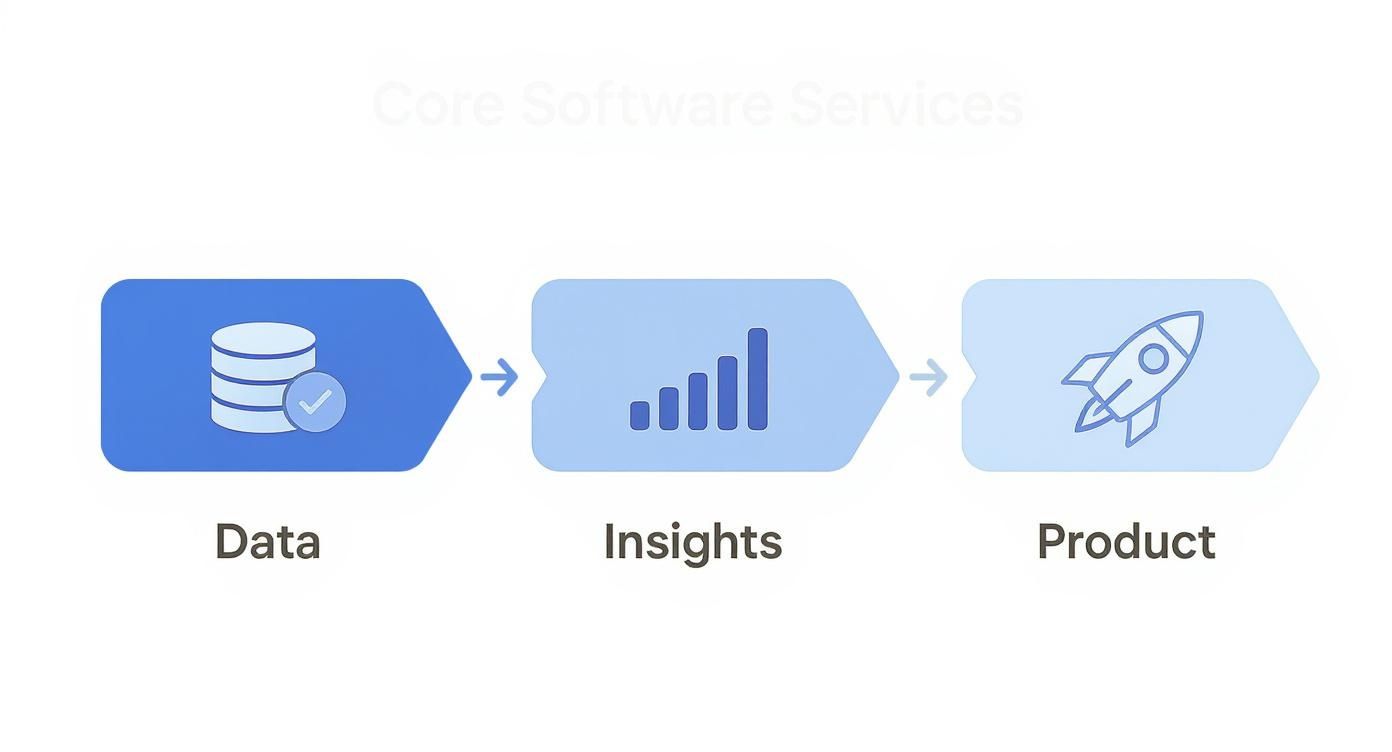
Great software isn't just about clever code. It starts with a solid data foundation and a clear understanding of the business goals.
Phase 1: Discovery and Strategy
This initial phase is the most important. Before any code is written, we need to get to the heart of your business and define what success looks like.
We work together to:
- Clarify Business Goals: What problem are we solving? Is the objective to boost efficiency, create a new revenue stream, or gain better visibility into your data?
- Identify Key Users: Who will use this software daily? What do they need to perform their jobs better and faster?
- Define Project Scope: We map out the core features for the first version, deciding what is essential for launch and what can be added later.
A clear strategy prevents costly detours and scope creep down the line.
Phase 2: UI and UX Design
Once the strategy is set, we design the software's look and feel. This involves two key components: User Interface (UI) and User Experience (UX).
UI is about the visuals—the buttons, screens, and layouts. UX is about the overall experience. Is it intuitive and easy to use?
A thoughtful design ensures your team can adopt the new tool quickly without extensive training. The goal is a smooth, logical experience that simply works.
Phase 3: Development and Iteration
This is where we bring the designs to life. Using the strategy and blueprints, we begin building the application. We use an iterative approach, often starting with a Minimum Viable Product (MVP).
An MVP isn't an incomplete product; it's the simplest version of your software that solves the core problem for your first users.
Building an MVP is a smart way to manage risk. It gets you to market faster, lets you gather feedback from real people, and helps you make data-driven decisions about what to build next, instead of just guessing.
We develop the software in short cycles ("sprints"), delivering working pieces for your review at each stage. This continuous feedback loop is crucial—it ensures there are no surprises at the finish line. To learn more, our guide breaks down how to ensure a custom software project succeeds.
Phase 4: Quality Assurance and Deployment
Before launch, the software undergoes intensive Quality Assurance (QA) testing. Our team tests every feature, workflow, and button to find and fix any bugs. We ensure the application is stable, secure, and performs as expected on different devices and browsers.
Once it passes our tests and gets your final approval, we handle the deployment. This is when we make your application live. Our work doesn't end there; we provide ongoing support to ensure everything continues to run smoothly.
Ready to turn your software idea into a real-world tool? Contact DataSimplified to discuss your project.
How to Choose the Right Development Partner
Choosing a custom software development company is like bringing on a new business partner. The right choice can accelerate your growth, while the wrong one can lead to wasted time, blown budgets, and a product that misses the mark.
You need more than a team that can code. You need a partner that understands your business and functions as an extension of your own team. For a South African business, it's vital to find a team that understands the local landscape and can translate your operational challenges into practical software solutions.
Beyond the Portfolio: What Really Matters
A slick website and a glossy portfolio are standard. To properly vet a potential partner, you must dig deeper into how they work and determine if their approach aligns with yours.
True compatibility is found in their processes, communication style, and understanding of your industry.
Here’s what you should be looking for:
- Industry Know-How: Do they understand the challenges of your sector? A team with relevant experience will get up to speed faster and build a more effective solution.
- Clear Communication: How do they provide updates, handle bad news, and incorporate feedback? Look for a partner who prioritises clear, consistent communication.
- A Solid Track Record: Have they successfully delivered projects of similar size and complexity? Ask for case studies or to speak with other clients.
- Post-Launch Support: What happens after the software goes live? A dependable partner offers ongoing maintenance and support to ensure your system remains secure and effective.
Critical Questions to Ask Potential Partners
Having the right questions ready helps you cut through the sales pitch and understand how a firm operates. Your goal is to get a clear picture of their methodology and commitment to your success. When evaluating potential partners, it's useful to have essential questions to ask a UX design agency to ensure they align with your vision.
Here are a few essential questions:
- Project Management: "Can you walk me through your development process? What methodology do you use, and how will you keep me updated on progress?"
- Team Structure: "Who will be my day-to-day contact? Can you tell me about the team who will be building my software?"
- Handling Scope Changes: "How do you handle changes in project scope once development is underway? What does that process look like?"
- Intellectual Property: "Who owns the source code and intellectual property once the project is complete and paid for?"
- Technology Stack: "How do you choose the right technology for a project? Can you explain why you would recommend a specific stack for our needs?"
Understanding Engagement Models
You will need to agree on an engagement model, which defines how you work together and handle billing. It should fit your project's scope, budget, and flexibility requirements.
Choosing the right engagement model is a strategic decision. It sets the financial and operational framework for the entire project, directly impacting your budget control and ability to adapt to new requirements.
Understanding these options helps you select the best structure for your goals.
Comparing Software Development Engagement Models
This table outlines the key differences between common engagement models.
| Model | Best For | Budget Control | Scope Flexibility |
|---|---|---|---|
| Fixed Price | Projects with a clearly defined scope and predictable requirements. | High: The budget is agreed upon upfront, providing cost certainty. | Low: Changes often require a new contract or change order. |
| Time & Materials | Projects with evolving requirements where flexibility is key. | Medium: You pay for the actual time spent, offering transparency but less predictability. | High: The scope can be adjusted easily as the project progresses. |
| Dedicated Team | Long-term projects or businesses needing an ongoing development resource. | Medium: You pay a fixed monthly cost for the team, making it predictable. | Very High: The team acts as an extension of your own, adapting to priorities as needed. |
Each model has its place. The key is to match the model to the reality of your project.
Need help finding the right development partner? Contact DataSimplified to discuss how we can build the solution your business needs.
Understanding Your Investment in Custom Software
When considering a custom solution, the first questions are often: "How much will it cost?" and "How long will it take?" The answer is: it depends. Every project is unique, and understanding the variables is key to setting realistic expectations.
The final cost reflects the project's size, the sophistication of its features, and the technology required. A straightforward internal Power BI dashboard will have a different price tag than a full-scale SaaS product designed for thousands of customers.
Key Factors That Influence Project Costs
The price of custom software is determined by the time and expertise needed to deliver a high-quality, secure, and scalable solution.
Three main elements shape the investment:
- Project Complexity: A system that automates a single task is less complex (and less expensive) than one that juggles complex business rules, multiple user types, and heavy data processing.
- Feature Set: The number and sophistication of features is a major cost driver. A basic login is simple; adding two-factor authentication and social logins adds significant development time.
- Technology Stack: The choice of programming languages, databases, and third-party services all impact the cost. Specialised technology or integration with legacy systems often requires niche expertise.
For a deeper dive, check out our guide on estimating your software project costs.
Timelines and the Importance of a Discovery Phase
Just like cost, timelines vary. A well-planned MVP might take three to six months, while a more involved data engineering and business intelligence solution could take longer. A thorough discovery phase is critical for getting an accurate estimate.
An upfront discovery phase isn't an optional extra; it's the most critical step for budget and timeline accuracy. Skipping it is like trying to build a house without blueprints—a recipe for costly rework and delays.
During this initial phase, a development partner gains a deep understanding of your business goals, maps user workflows, and defines technical requirements. This results in a clear project roadmap, which is the foundation for a reliable estimate.
The South African Advantage
Working with a local South African development partner offers a significant financial advantage. You get access to world-class technical skills at globally competitive rates. This makes custom-built software more attainable for local businesses that want to innovate without an enterprise-level budget.
For instance, many South African custom software development firms charge significantly less than their European or North American counterparts, with some rates falling under USD 25 per hour. You can learn more about South African software development rates, which makes advanced technology more accessible.
This cost-effectiveness means local businesses can invest in powerful tools—like data automation, custom dashboards, and unique applications—that drive tangible growth.
Need help scoping your next project to get a clear cost and timeline? Contact DataSimplified to discuss a solution that fits your budget and business goals.
Why Custom Software Is a Strategic Asset, Not an Expense
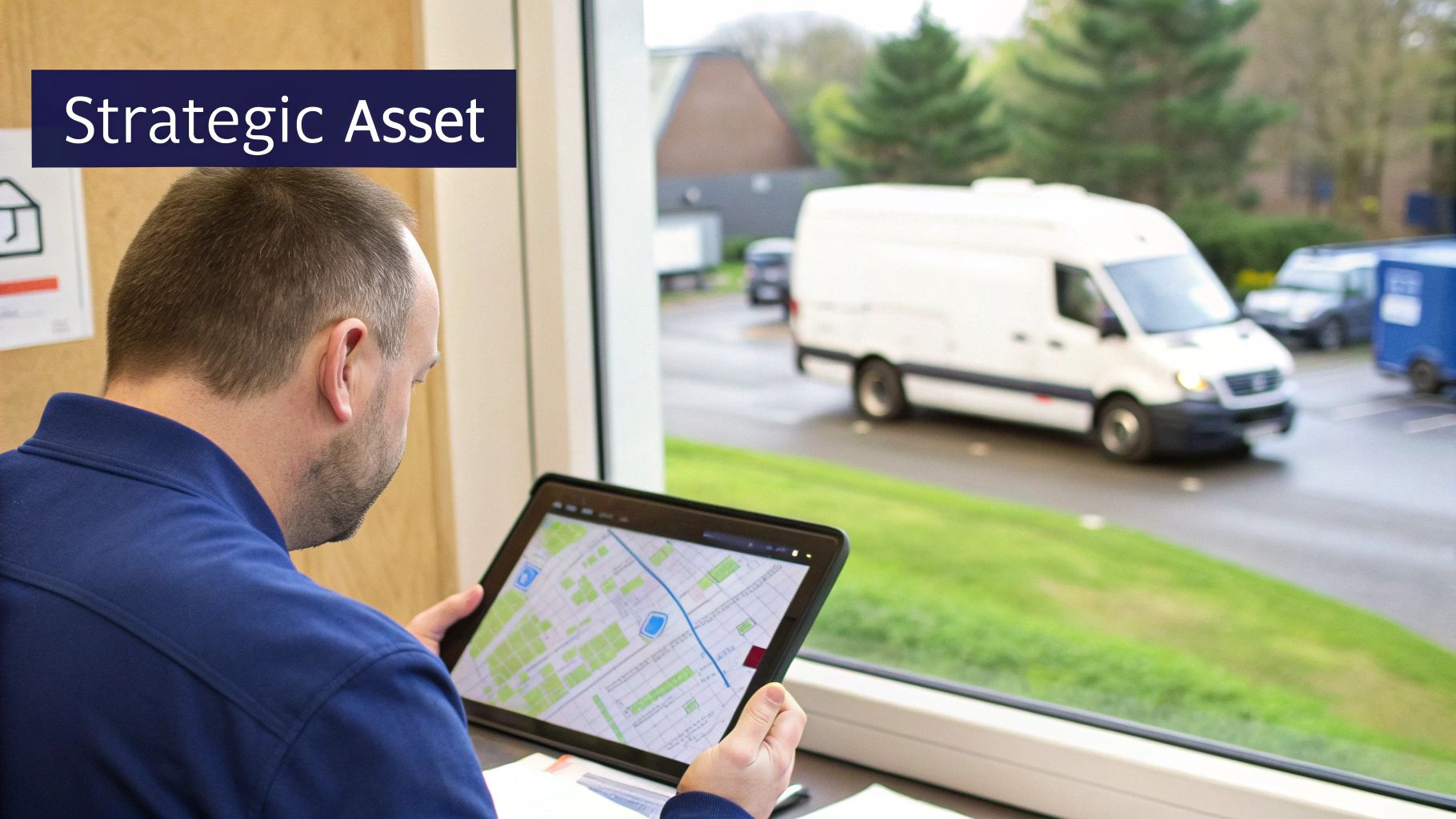
It's easy to view custom software as an expense. A more accurate perspective is to see it as a long-term strategic asset—a tool that builds a competitive moat around your business.
Off-the-shelf products often force you to adapt your processes to their rigid structure. Custom software does the opposite: it’s built to fit you. You're not just buying a tool; you're investing in a solution moulded to your workflows, designed to grow with you.
Unlocking a True Competitive Advantage
The real value of custom software lies in the unique advantages it delivers, directly impacting your bottom line and operational resilience.
Here’s what that looks like in practice:
- Perfect Scalability: A bespoke solution is designed to handle your growth. As your customer base or operational complexity increases, the software scales with you, avoiding a costly replacement.
- Enhanced Security: You control the security protocols. This allows you to implement robust, industry-specific measures to protect sensitive data—a major advantage over generic platforms.
- Seamless Integration: Custom software is built to connect with your existing systems without friction. This eliminates data silos and manual workarounds, creating a smooth, efficient ecosystem.
Real-World ROI: A South African Example
Consider a mid-sized logistics company in South Africa struggling with inefficient routes and high fuel costs. Off-the-shelf fleet management tools were too generic, failing to account for local traffic patterns or specific delivery windows.
They partnered with a custom software development company to build a bespoke routing application. The new solution used real-time GPS data and historical traffic information to create optimal daily routes. The result? A 15% reduction in fuel consumption within six months. This tangible ROI demonstrates how you can start transforming your business with custom software development.
Investing in a solution built for your specific challenges empowers your business to innovate, adapt, and achieve sustainable growth. It’s not about buying software; it’s about building a long-term operational advantage.
The global custom software development market is expected to grow from USD 44.52 billion in 2024 to USD 53.95 billion in 2025—a growth rate of 21.2%. This shows that businesses everywhere recognise custom solutions as a key asset. You can explore more on this growing market on TheBusinessResearchCompany.com.
Ready to build a strategic asset that drives real business results? Contact DataSimplified to discuss how a custom solution can work for you.
Frequently Asked Questions About Custom Software
When considering custom software, many questions arise. Here are answers to some of the most common ones we hear from business owners.
What’s the difference between custom and off-the-shelf software?
Off-the-shelf software is like a standard-sized suit—it's made for everyone, so it fits no one perfectly. You often get features you don't need while missing functions that are critical to your operations.
Custom software is a tailor-made suit. It’s designed from the ground up to fit your business, matching your exact processes. You own it, turning it into a valuable company asset rather than just another monthly subscription.
Why start with a Minimum Viable Product (MVP)?
Starting with an MVP is the smartest way to build software. Instead of building the entire vision at once, an MVP focuses on getting a working, core version of your product to real users as quickly as possible.
This approach is about learning fast. An MVP allows you to test your core idea, gather feedback, and validate that there is a genuine need for your solution. It prevents you from wasting money on features nobody wants.
How is my intellectual property (IP) protected?
Your idea and its code are valuable assets. A professional development partner will clarify IP ownership in your contract from the start.
Typically, once the final payment is made, full ownership of the source code and all intellectual property transfers to you. This should be explicitly stated in your service agreement, giving you complete legal control.
What happens after the software is launched?
Building the software is just the beginning. It needs regular maintenance to remain secure and efficient. Ongoing support typically covers:
- Security: Applying regular updates and patches to protect against new threats.
- Bug Fixes: Identifying and fixing issues that emerge during real-world use.
- Performance Monitoring: Ensuring the system remains fast and reliable as your user base grows.
Need help building your next Power BI dashboard or data automation workflow?
Contact DataSimplified to discuss how we can turn your business data into powerful insights.
https://datasimplified.co.za
