
A data governance framework is the official rulebook for your company's data. It defines who can do what, with which data, and under what circumstances. For any growing business, this framework is the line between data chaos and a single source of truth that fuels confident decisions. It ensures your data stays accurate, consistent, and secure.
Why Data Governance Matters for Your Business

Imagine building an office block without municipal building codes. One contractor might use shoddy materials, while another cuts corners on safety. The result would be an unstable, dangerous structure unfit for purpose. A data governance framework is the essential building code for your company's data assets.
It provides a structured way to manage information, preventing the digital equivalent of a building collapse. For small and mid-sized businesses in South Africa, this isn't just an IT issue; it's a core business function. Without clear rules, data becomes inconsistent and untrustworthy, leading to flawed reports and poor strategic choices.
The Cost of Data Chaos
When data is ungoverned, teams work in silos. Your sales department might track customer details one way, while the finance team does it completely differently. This creates multiple, conflicting versions of the truth. This chaos makes it nearly impossible to build reliable Power BI dashboards or trust the insights you generate.
A lack of governance typically leads to key problems:
- Poor Decision-Making: Inaccurate data leads to bad business decisions that cost money and customers.
- Operational Inefficiency: Teams waste time arguing over which numbers are right instead of using information to move the business forward.
- Compliance Risks: In South Africa, failing to manage personal information properly can lead to significant penalties under the Protection of Personal Information Act (POPIA).
A Foundation for Growth and Compliance
A well-designed data governance framework tackles these problems by establishing clear ownership, setting data quality standards, and managing access. It becomes the bedrock for all your data projects, from basic business intelligence reports to advanced analytics. It is also non-negotiable for meeting legal requirements like those governing EU data sovereignty, which highlight the importance of solid data management.
A pragmatic framework focuses on business value, not excessive complexity. It’s about putting just enough structure in place to ensure your data is a reliable asset that supports growth, rather than an administrative burden that slows you down.
By creating a single, trusted source of data, you empower your teams to work more effectively and make smarter decisions. You can dive deeper into this topic in our other articles about data governance. This systematic approach is the first step in turning raw data into a strategic advantage.
The Building Blocks of a Strong Framework
A data governance framework does not have to be an intimidating, enterprise-level project. For a small or mid-sized business, it’s about setting up practical rules and giving people clear responsibilities. Think of it as four core pillars that bring structure and clarity to your company’s data.
These pillars demystify governance by breaking it down into manageable components you can implement without a massive budget. The goal is to build a foundation that is fit for purpose and delivers immediate business value.
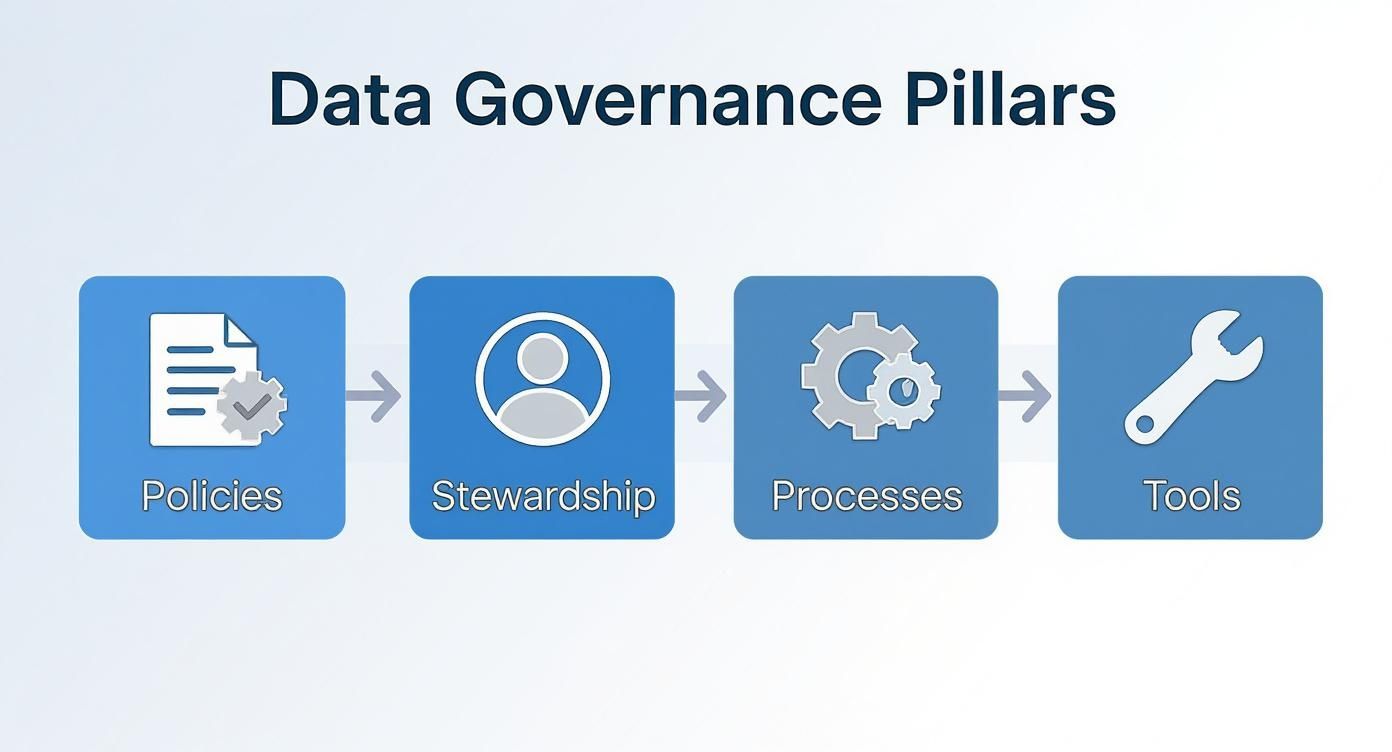
Pillar 1: Data Policies (The Rulebook)
The first pillar is creating simple, clear Data Policies. These are not dense, technical documents; they are straightforward rules defining how data should be handled across the business.
Policies answer critical questions like:
- Who is allowed to see customer financial information?
- What does a "complete" client record look like in our system?
- How is personal information collected, stored, and deleted to comply with POPIA?
By establishing these guardrails, you set clear expectations for everyone. This is fundamental to improving data quality for business success, as it ensures data is managed consistently from the moment it enters your systems.
Pillar 2: Data Stewardship (Clear Ownership)
Once you have rules, you need people to uphold them. This is where Data Stewardship comes in. A data steward is someone within your business who takes responsibility for a specific type of data. This isn't about hiring someone new; it's about assigning ownership to existing team members who know the data best.
For example:
- An Operations Manager could be the steward for sales and customer data.
- A Senior Accountant is the natural steward for financial data.
Appointing stewards transforms data governance from an abstract concept into a tangible responsibility. It ensures there is a go-to person accountable for the quality and security of a specific data domain.
This hands-on approach avoids the common trap of data being managed in disconnected silos. By assigning stewards, SMEs can create a far more agile and effective oversight structure than larger enterprises.
Pillar 3: Processes & Workflows (Standardised Actions)
The third pillar is defining your Processes & Workflows. These are the standardised steps your team follows to manage data. This covers everything from how a new customer is added to the approval process for a new Power BI report.
Standardising these actions reduces errors and boosts efficiency. For instance, a simple checklist for onboarding a new supplier ensures all required information is captured correctly every time. This systematic approach is a core part of effective data engineering and implementing robust data versioning and management practices.
Pillar 4: Technology & Tools (Smarter Usage)
Finally, the fourth pillar is Technology & Tools. For an SME, this isn't about buying expensive software. It's about getting more out of the systems you already own.
Your existing tools can play a vital role. For example, Power BI is more than a dashboarding tool. Its data cataloguing features can help document where your key data lives and what it means, creating a simple inventory of your data assets. Similarly, metadata—the "data about your data"—can often be managed within your existing databases or CRM. Using these tools properly builds a practical governance foundation without adding unnecessary costs.
Your Step-by-Step Implementation Roadmap
Building a data governance framework is a journey of steady improvements, not a single, overwhelming project. This roadmap breaks it down into manageable phases, focusing on progress over perfection.
Phase 1: Secure Leadership Buy-In
Before you write a single policy, your leadership team must be on board. Data governance initiatives often fail when seen as a purely technical issue. Frame it as a business strategy that delivers tangible results.
Build a business case using the language of outcomes:
- Risk Reduction: Explain how clear data policies and access controls ensure POPIA compliance, helping avoid costly fines.
- Accurate Reporting: Show how a single source of truth provides reliable Power BI dashboards for confident decision-making.
- Operational Efficiency: Point out how much time teams waste cleaning messy data. Standardised processes give that time back to the business.
Your goal is to find an executive sponsor who will champion the initiative and secure the necessary resources.
Phase 2: Assemble Your Governance Team
You don't need to go on a hiring spree. Your first governance team should be a small, cross-functional group of people who understand the business and its data.
Pull in representatives from key departments:
- Sales or Operations: They know the customer data and daily quality struggles.
- Finance: They live and breathe data integrity.
- IT: They manage the systems where data resides and can offer technical expertise.
This core group will define the first policies and appoint data stewards, ensuring the framework solves real-world problems.
Phase 3: Start Small and Define Initial Policies
Trying to govern all your data from day one is a recipe for failure. Pick one critical data domain to start with, such as customer data or financial data, where errors cause the biggest headaches.
With your focus area chosen, work with your team to draft a few simple, foundational policies. For customer data, your first policies might be:
- A standard format for capturing all new customer addresses.
- A rule that every new record must have a valid phone number and email.
- A clear definition of an "active" versus "inactive" customer in your CRM.
Documenting these simple rules delivers an early win and builds momentum for future expansion.
Phase 4: Deploy Tools and Communicate Clearly
Technology should support your process, not drive it. As an SME, you can make great progress with tools you already have, like using Power BI to build a basic data dictionary or shared documents to log policies.
At the same time, communicate the 'why' behind these new rules to the entire organisation. Run a short workshop or send a clear memo explaining the new policies and their benefits. When people understand how cleaner data makes their own jobs easier, they are more likely to adopt the new processes.
This phased approach has proven its worth. The Gauteng City-Region Observatory (GCRO) in South Africa successfully rolled out its data governance strategy by forming a committee and focusing on core principles like data quality. As a result, 92% of their datasets met high standards, and data usage increased by 40%. You can learn more about the GCRO's data governance strategy and its outcomes. By following a similar step-by-step method, any SME can achieve impressive results.
How to Measure Success
A data governance framework is useless without a way to measure its impact. To maintain business-wide support, you must prove that the effort is making a tangible difference. This means moving beyond abstract ideas and tracking Key Performance Indicators (KPIs) that a business owner or operations manager cares about.
Assess Your Starting Point
Before measuring progress, you need to know where you stand. A simple maturity model helps assess your current data habits and map out a realistic path forward.
- Level 1: Chaotic – Data is managed in silos with no consistency or ownership.
- Level 2: Aware – The business recognises data issues, but efforts to fix them are reactive and isolated.
- Level 3: Defined – Formal policies are documented, and data stewards are assigned to key areas.
- Level 4: Managed – Governance is an active part of business operations, with KPIs and data quality actively monitored.
- Level 5: Optimised – Governance is embedded in the company culture. Data is a strategic asset, and processes are continuously improved.
By identifying your current level, you can set an achievable target for the next 6-12 months. For most SMEs, moving from 'Chaotic' to 'Defined' is a massive win that delivers immediate value.
Set KPIs That Matter
Once you know your starting point, set KPIs tied directly to business outcomes. The best KPIs answer the simple question: "So what?"
Here are a few practical examples:
- Time saved preparing monthly reports: A reduction proves that cleaner data is speeding up your reporting processes, a key benefit of effective data and reporting solutions for your business.
- A drop in data errors flagged by finance: This directly measures improved data quality, meaning less time spent on manual fixes and more trust in financial data.
- Faster customer onboarding: Effective data entry processes allow front-line teams to set up new clients more quickly and with fewer mistakes.
Tracking these metrics, perhaps in a simple Power BI dashboard, turns your data governance framework from a theoretical exercise into a business initiative that drives real value.
Need help building your next Power BI dashboard or data automation workflow? Contact DataSimplified to discuss how we can turn your business data into powerful insights.
Common Governance Pitfalls to Avoid
Launching a data governance framework is a significant achievement, but maintaining momentum is the real challenge. Many initiatives fail because they fall into common and avoidable traps. Knowing these pitfalls can be the difference between a framework that helps your business and one that creates more frustration.
The "IT-Only" Silo
One of the quickest ways to doom a data governance initiative is to treat it as a technical problem for the IT department to solve alone. While IT manages the systems, it's the people in sales, finance, and operations who use the data daily.
When the business isn't driving the process, the framework becomes disconnected from reality. The rules look good on paper but fail to solve actual problems.
Key Takeaway: Data governance requires a partnership between business and technology. Form a governance council with people from across the company to ensure you are focused on solving real-world issues.
Trying to Boil the Ocean
It’s tempting to create a perfect, all-encompassing framework from day one. This "boil the ocean" approach almost always leads to paralysis, as the project's scale becomes impossible for a small team to handle.
Successful data governance starts small and proves its worth with quick wins.
- Solve one big headache first: Pick a single, high-impact area where bad data is causing visible pain, like messy customer data or unreliable financial reports.
- Keep it simple: Start with three to five clear, straightforward policies that address the immediate problem.
- Grow from there: Use early success to build momentum, then gradually expand your framework to other parts of the business.
Forgetting the "People" Part
Many leaders underestimate the cultural shift that data governance requires. It’s not enough to write policies; you must explain the "why." If your team sees governance as just another set of restrictive rules, they will find ways to work around them.
Effective communication is essential. Frame governance as something that makes everyone's job easier by providing more reliable and trustworthy data. This is a real challenge in South Africa, where exploring the challenges of effective data governance in Africa is an ongoing conversation. A strong, well-communicated governance framework is the most direct way to address these vulnerabilities.
Steering clear of these pitfalls comes down to a practical, business-first mindset. Start small, involve the right people, and communicate continuously.
We Can Help You Build Your Framework
Implementing a data governance framework can feel daunting. For a growing business where everyone wears multiple hats, it can seem impossible. The good news is you don't have to do it alone.
DataSimplified specialises in building practical, fit-for-purpose data solutions for South African SMEs. We help you achieve enterprise-level results without the enterprise-level cost.
A Pragmatic, Business-First Approach
We don't start with a rigid rulebook. We start by listening to your most pressing business pains, whether it's unreliable reports or compliance worries. We focus on delivering quick, tangible wins that demonstrate the value of good governance from day one, often using the tools you already own, like Power BI.
A successful data governance framework is built on solving real business problems. It should make work easier and decisions clearer, not add bureaucracy.
Our Expertise Is Your Advantage
We combine deep technical know-how with a solid understanding of business realities. Our team has you covered across the full data lifecycle:
- Data Engineering: We build solid data foundations to fix the root causes of data chaos.
- Business Intelligence: We turn your governed data into insightful Power BI dashboards your team can rely on.
- ETL and Integration: We connect your systems to create a single, reliable source of truth for your organisation.
Our job is to translate complex data challenges into reliable, actionable insights that give you the confidence to make better decisions.
Frequently Asked Questions
Data governance can sound complex, especially for a small or medium-sized business. Here are straightforward answers to common questions.
How Long Until We See Results?
You don’t have to wait months. A practical approach delivers value almost immediately. By focusing on one high-pain area first—like cleaning up CRM data—you can see a real difference in data quality and reporting accuracy within a single business quarter. The key is to aim for quick wins that prove the value of the initiative.
Do We Need to Hire a Data Governance Team?
No. For most SMEs, hiring a dedicated team is not practical. Good data governance is about giving clear responsibilities to the people you already have. Your operations manager is the perfect Data Steward for customer data, and a senior finance person is the natural choice to own financial data. It’s about leveraging the knowledge already within your business.
Can We Start If Our Data Is a Mess?
Yes. In fact, that is the best time to begin. A data governance framework is the tool designed to bring order to chaos.
Admitting your data is a mess is the first step. The framework gives you a structured way to clean it up and—crucially—keep it clean. It helps you move from constantly fighting data fires to proactively managing your information.
Isn't This Just for POPIA Compliance?
While a data governance framework is essential for POPIA compliance, its value runs much deeper. It is the foundation for everything else you want to do with your data. Good governance is what allows you to trust the numbers in your Power BI dashboards and gives you the confidence to make sharp, data-driven decisions that push your business forward.
Need help building a data governance framework that actually drives business value? Contact DataSimplified to discuss how we can turn your data into a powerful asset.
