
B2B marketing automation uses dynamic workflows and data automation to deliver personalised messages at scale. Combined with robust data engineering and ETL and integration pipelines, it feeds real-time insights into Power BI dashboards and business intelligence reports. Here’s how South African SMEs can map, build and measure end-to-end campaigns to drive revenue.
How B2B Marketing Automation Works
Once you connect your CRM and email platform via ETL and integration pipelines, every interaction feeds into a dynamic system that responds to buyer behaviour. For South African small-mid businesses, this means one-off email blasts evolve into personalised journeys, scaling outreach without adding headcount.
- Integrated CRM and Email Platforms centralise customer data and touchpoints
- Lead Scoring Models assign points for actions like webinar sign-ups or content downloads
- Automated Triggers launch follow-ups based on clicks, site visits or form completions
Regional demand is rising in Cape Town, Johannesburg and Durban. Globally, the marketing automation market hit USD 6.8–8.0 billion in 2024–2025, with a projected 12.5% CAGR through 2032. Locally, specialist agencies often start at around USD 1 000-equivalent retainers. For detailed forecasts, see the full report on Archive Market Research.
Benefits For SMEs
Automation frees marketing teams from repetitive tasks, letting them concentrate on strategy and creative campaigns. Faster, consistent follow-ups translate into measurable gains:
- Shorter response times boost engagement
- Automated sequences drive higher conversion rates
- Clear analytics deliver actionable ROI insights

This overview highlights core elements such as lead nurturing, scoring and multichannel orchestration. In the next sections, you’ll discover how to map out, build and measure end-to-end workflows that drive revenue.
Understanding The Key Concepts
Think of an automated workflow as a bespoke conveyor belt that gently guides prospects from their first spark of interest right through to sales-qualified leads. In practice, this means your team isn’t scrambling to follow up—every interaction happens automatically, yet feels personal.
A South African tech SME, for instance, configured a trigger to reach out to webinar sign-ups within minutes. The result? Conversions jumped by 30%, and the sales cycle shrank noticeably.

Core Automation Functions
Lead scoring hands out points for behaviours—like attending a demo or downloading a whitepaper—so your marketing team can zero in on the hottest contacts first.
Multi-stage email nurture weaves together timed campaigns that shift based on how recipients engage. It’s like a conversation that adapts to every click or open.
Account-based flows, on the other hand, treat each key account as its own unique journey. Messages are crafted around the account’s specific pain points and buying stage.
- Lead Scoring: Ranks prospects using behaviour and firmographics.
- Email Nurture: Sends relevant content at scale, adapting in real time.
- Account-Based Marketing: Delivers highly personalised outreach for strategic targets.
67% of B2B marketers in South Africa report at least a 10% increase in their sales pipeline from automation.
Automation in South Africa has climbed steadily since 2019. Recent snapshots for 2023–2025 show 46% of B2B organisations rely heavily on marketing automation. Dive deeper into these insights in the InBeat Agency Industry Report.
Benefits For SMEs
Even with lean budgets, you can achieve enterprise-grade ROI. Properly designed workflows have driven 80%+ uplifts in qualified leads when nurturing runs at scale.
Consistent touchpoints across email, social and ads make sure your brand stays front of mind, wherever prospects travel online.
- Faster response times reduce lead decay and boost engagement.
- A unified message across channels builds trust and recognition.
- Close collaboration between marketing and sales smooths out handoffs and lifts conversion rates.
Aligning teams around shared automation rules means no more manual to‐and‐fro. Small and mid-market outfits often see revenue climbs without the overhead of big‐ticket platforms. In fact, SMBs prioritising data hygiene and integration frequently match global benchmarks—sometimes achieving 451% growth in qualified leads.
Next, we’ll map out how to design workflows and pick the right automation components for your campaigns.
Campaign Journey Examples
Picture an SME in Cape Town running a three-step webinar journey that requires zero manual touch:
- Step 1: Thank-You Email
Sent immediately, it highlights key take-aways and includes a quick survey link. - Step 2: Case Study Share
Three days later, attendees receive a relevant case study to deepen their interest. - Step 3: Demo Invitation
One week after sign-up, a sales task is triggered alongside a personalised demo invite.
Leads get timely, tailored outreach without anyone having to hit “send.” You can also tweak each step based on who opens the email or clicks a link.
For account-based journeys, swap in executive summaries or board-level insights instead of generic content—boosting relevance and buy-in at the top.
Adjust these journeys as your data and results evolve.
Designing Workflows And Automation Components
Building a marketing automation workflow is like arranging a symphony: each instrument must play its part at the right moment. You’re not simply connecting tools—you’re crafting a funnel that smoothly moves prospects from first contact to sales-ready conversations.
Start with these core building blocks:
- Email Nurture Sequences
- Drip Campaigns
- Lead Scoring Rules
- Event-Triggered Actions
- Account-Based Plays
Triggers are the heartbeat of your system. When a prospect registers for your Cape Town start-up’s webinar, imagine sending them a whitepaper within five minutes—no manual steps required.
- Email Nurture Sequences can drive 52% higher open rates by delivering content based on individual behaviour.
- Drip Campaigns release content in stages, gently guiding prospects along the buyer’s journey.
- Lead Scoring Rules assign points for actions and firmographic details, so sales teams focus on the hottest opportunities.
- Event-Triggered Actions fire instantly when someone views a page, downloads a guide, or joins your webinar.
- Account-Based Plays treat each target account as its own micro-campaign, with messaging designed just for them.
Tie these elements together, and you’ll automate personal touches at scale. For example, one mid-market firm blended lead scoring with real-time triggers and saw a 35% increase in MQL conversion in just three months.
Personalising Messages At Scale
True personalisation goes beyond “Hello [First Name]”. It means swapping in details—company size, sector pain-points or recent interactions—so each email feels handcrafted.
- Use contact and company tokens to insert names, roles and industries.
- Leverage behavioural data to serve up conditional content blocks.
- A/B test subject lines and message variations for each segment.
And don’t forget compliance: implement robust consent management to stay on the right side of POPIA. Respect builds trust.
Mapping Components Into Funnels
Think of your funnel as a tree:
- Define Entry Triggers (form fills, webinar sign-ups).
- Craft Nurture Tracks that adapt when contacts click, download or reply.
- Set Lead Scoring Thresholds to hand off qualified leads to sales.
- Automate Notifications so nothing falls through the cracks.
Always pilot new sequences on a small group first. That way you catch errors early and refine your messaging. Add branching logic to address different buyer personas and their unique needs.
The drag-and-drop builder in this platform shows how triggers, delays and actions blend into a clear, visual workflow.
Marketing Automation Workflow Comparison
| Workflow Type | Purpose | Key Channels |
|---|---|---|
| Email Nurture Sequence | Engage prospects with tailored, relevant content | Email, Social Media |
| Drip Campaign | Deliver staged content over a set timeline | Email, SMS |
| Lead Scoring Automation | Prioritise high-intent leads for sales follow-up | CRM, Email Platform |
| Event-Triggered Action | React instantly to prospect behaviour | Website, Email |
| Account-Based Play | Run custom journeys for strategic accounts | Email, LinkedIn Ads |
Each approach shines in different scenarios. Email nurture works wonders for awareness, while account-based plays zero in on high-value deals. Match your choice to the specific goals you’ve mapped out.
Conclusion
When you integrate these workflows with CRM systems and ETL pipelines, data flows seamlessly and insights stay fresh. Sync closely with your sales team and schedule regular reviews of scoring rules and triggers—this keeps your funnel sharp and efficient.
For more detailed strategies, take a look at our guide on partner programme analytics.
Building Data Architecture And Integration
A solid data foundation is essential for reliable B2B marketing automation. When your systems exchange clean, standardised information through data engineering best practices, triggers fire on time and metrics stay in sync.
Data Hygiene Best Practices
Before you launch any workflow, start with a clear dataset. Routine cleansing removes duplicates and fixes formatting errors in fields like country codes or industry labels.
Automated scripts can spot anomalies—missing values, malformed emails or phone numbers—early on. Teams who implement these checks often slash manual clean-up by up to 80%.
- Deduplication routines that merge identical records while preserving history
- Validation rules enforcing formats for emails, phone numbers and dates
- Reference tables to standardise values (e.g. industry sectors, regions)
Schema Design For Consistency
A well-defined schema unifies record structures across every system. It gives each contact or account a single source of truth, making segments for email nurturing or lead scoring far more reliable.
Choose precise field names—engagement_score instead of a generic “score,” for instance. That consistency across ETL scripts, dashboards and automation workflows cuts down on errors.
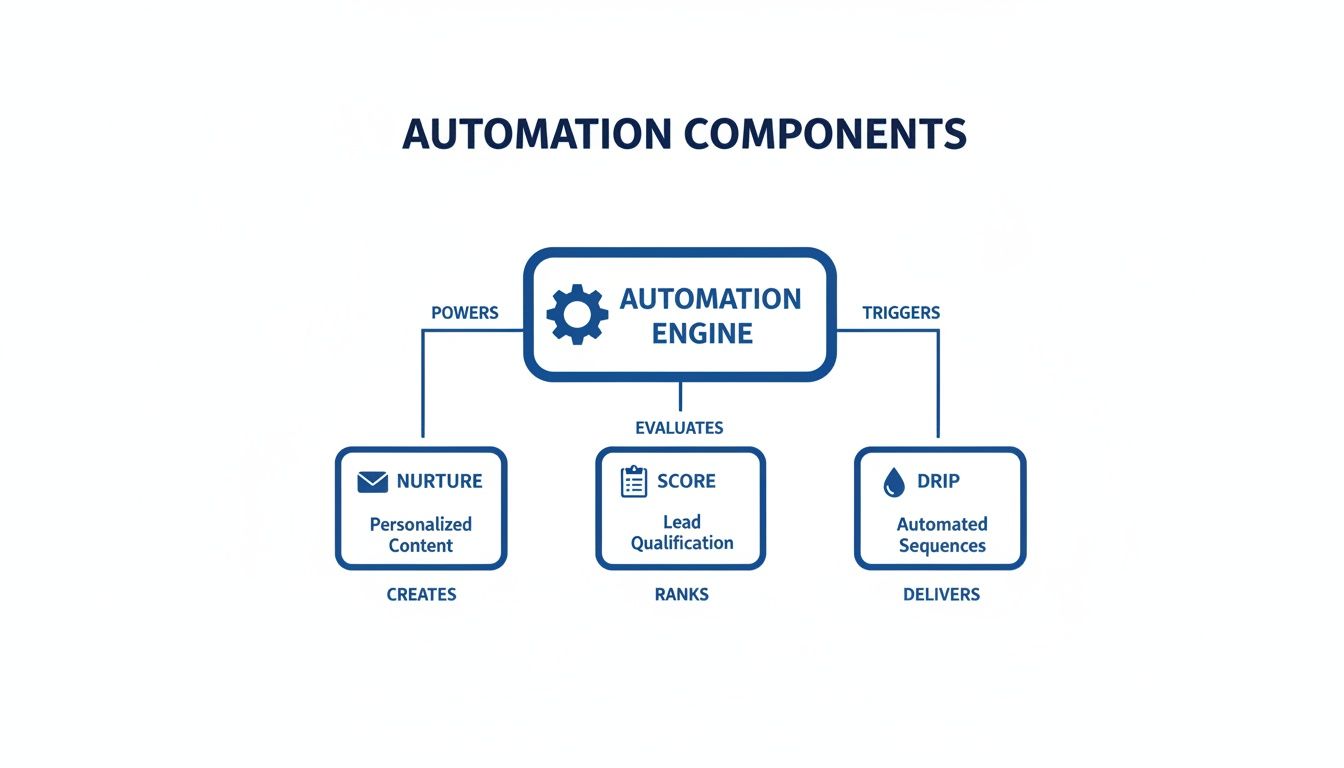
The diagram below illustrates how nurture, scoring and drip campaigns interact within a cohesive automation workflow.
Real Time Data Sync
Keeping your CRM and data warehouse in lockstep is crucial. When HubSpot or Salesforce updates a lead, you want that change reflected in seconds.
Use tools like Azure Data Factory or custom APIs for low-latency transfers. A simple dashboard can monitor lag times and automatically retry failed jobs.
- Identify key objects (contacts, accounts, activities) for real-time updates
- Configure middleware to map CRM fields to warehouse tables
- Set up alerting for sync errors or job failures
Governance And Compliance
Strong data governance protects privacy and ensures you comply with POPIA in South Africa. Define who can view or edit records—and under what conditions.
Establish retention schedules and consent flags to honour opt-out preferences. Document data lineage so every marketing action can be traced back to its source.
“Clear governance frameworks reduce privacy risks and build trust across teams and customers.”
Middleware Selection Tips
Picking the right middleware depends on your stack and data volume. A lightweight iPaaS suits simple CRM setups, while a dedicated ETL platform handles large-scale transformations.
- Use Azure Logic Apps for Microsoft-centric environments with low to medium throughput
- Consider MuleSoft for multi-cloud integrations and strict security policies
- Evaluate open-source tools like Apache NiFi when you need custom transformation logic
Prototype with sample data to surface performance bottlenecks before you go live—saving both time and budget.
Check out our guide on data integration to deepen your understanding of ETL pipelines and system connections.
Measuring Impact With Analytics And Reporting

Data-driven insights keep your automation tuned for peak performance. To make B2B marketing automation succeed, start by defining clear metrics and checking them on a regular basis. Without a focused reporting structure, you risk missing critical shifts in your audience’s behaviour.
Tracking Open Rate shows initial engagement, while MQL Conversion and Pipeline Attribution reveal how leads flow through your funnel. An Engagement Score ties all touchpoints together for a fuller picture.
- Open Rate: Percentage of recipients who open your emails
- MQL Conversion: Number of Marketing Qualified Leads created
- Pipeline Attribution: Campaign-to-revenue stage connections
- Engagement Score: Composite measure of activity across channels
Dashboards become your command centre, giving stakeholders a single view of every campaign’s progress. Feed these figures into business intelligence tools and Power BI dashboards, and automate data extraction from HubSpot or Marketo via ETL pipelines. Scheduled refreshes keep your charts up to date as new clicks and leads roll in.
Setting Up Real Time Dashboards
Begin by linking your marketing automation platform to a data warehouse or Customer Data Platform (CDP), which acts as your central hub for campaign events. Use middleware like Azure Logic Apps or Apache NiFi to move data in a scalable way. Map key fields—send date, click count and lead score—into warehouse tables for easy querying.
Pro Tip Monitor data latency under five minutes to keep insights fresh.
With connections in place, build custom report templates in Power BI or your BI tool of choice. Aim for visuals that mirror your sales funnel and highlight where prospects drop off. Use line charts for trend analysis and bar charts to compare segment performance.
Automating Report Refresh And Alerts
Use your BI service’s scheduling features to refresh reports right after each ETL job completes, removing manual steps. Configure data-driven alerts for key thresholds—such as open rates dropping below 20%—so no change goes unnoticed. Alerts can ping your marketing and sales teams through email or chat channels, prompting quick adjustments.
- Align report goals and metrics with stakeholders
- Map out data workflows and schedule ETL jobs in Azure Data Factory
- Build and test visuals in Power BI before sharing
- Document refresh timings and alert rules in your governance guide
By automating these steps, you eliminate manual handoffs and keep your insights up to date. It frees your team to focus on strategy rather than chasing spreadsheets. Regular iterations then let you tweak campaigns as performance evolves.
Interpreting Visual Trends For Decision Making
Dashboards often surface patterns you might miss in tabular reports. For instance, one mid-market firm spotted a 15% week-on-week decline in email opens among a key audience segment. Filters helped them isolate low click rates on specific content pieces.
| KPI | Underperforming Signs | Next Steps |
|---|---|---|
| Open Rate (<20%) | Flat or falling engagement | Refresh subject lines |
| MQL Conversion | Low lead-to-MQL ratio | Review nurture content |
| Pipeline Attribution | Gaps in touchpoint tracking | Check ETL mappings |
These insights drive targeted changes—tweaking headlines, refining workflows and boosting ROI over time. Integrating campaign KPIs into a unified data warehouse creates a single source of truth for cross-channel analysis. Shared dashboards keep everyone on the same page, from marketing to sales.
Learn more about campaign tracking in our guide on marketing performance tracking.
Conclusion
Regularly reviewing KPIs and dashboards lets you pivot swiftly and align marketing with sales objectives. Even lean teams can rely on automated reporting to fuel continuous improvement and maintain clear ROI visibility. Implement these practices to refine your B2B marketing automation strategy with data you can rely on today.
Implementation Roadmap And Common Pitfalls
Taking B2B marketing from idea to execution is a bit like planning a long road trip—you need a detailed map, clear milestones and regular checkpoints. This phased guide helps South African SMEs move step by step, from choosing the right platform to governance, with common traps marked in red.
By breaking work into stages—platform selection, workflow scoping, pilot testing and governance—you’ll keep teams focused and campaigns on target for ROI.
Selecting The Right Platform
Picking a marketing automation platform is like choosing the engine for your business car. It must match your company’s size, data inputs and budget.
Start by scoring options against what you really need. Consider:
- Integration Capability: Does it connect natively with your CRM and email system?
- Feature Set: Check for lead scoring, dynamic content, A/B testing and analytics.
- Scalability: Can it handle 10 000+ contacts without slowing down?
- Pricing Model: Compare subscription tiers, user licences and add-ons.
- Support And Training: Look for ZA-based partners or local support options.
Security matters too. Verify encryption at rest and in transit, and confirm data residency aligns with POPIA. User-friendly builders cut training time. For instance, a Johannesburg start-up trialled three platforms and picked the one that halved their integration work.
Scoping Initial Workflows
Once the platform is live, map out your first workflows like you’d plan a maze with clear entry points, signposts and exits.
Pilot each path on a small audience. That way, you spot logic gaps early and fine-tune messaging before a full launch.
- Define Objective: What outcome do you want? (e.g. webinar sign-ups, demo bookings)
- Identify Triggers: Form completion, page visits or lead-score thresholds
- Craft Messages: Personalise with tokens and dynamic blocks
- Set Delays: Space messages to avoid inbox fatigue
- Schedule Reviews: Check performance at 2-week and 4-week marks
Document every decision point in a simple flowchart. It makes troubleshooting faster and helps keep leads from falling through cracks.
Aligning Teams And Governance
Bringing marketing, sales and IT together from day one prevents silos and keeps everyone on the same page.
Define clear roles, so content approvals and data access don’t bottleneck.
- Assign Ownership: Marketing lead handles content and nurture design
- Set Schedules: Agree on launch dates, training sessions and reviews
- Document Processes: Record every step—from data cleansing to dashboard sharing
- Establish Policies: Draft guidelines for data use, consent and POPIA compliance
- Monitor Progress: Use a Kanban board or project tool to track tasks
Don’t forget change management. Run hands-on workshops and produce quick-start guides. Tools like Trello or Microsoft Planner keep everyone accountable.
Common Pitfalls And Solutions
Most campaigns stumble on a few familiar snags. Spot them early and you’ll save time, budget and stress.
- Neglecting Data Quality: Dirty records lead to wrong segments and bounces
- Over-Automating: Too many triggers without strategy can overwhelm contacts
- Skipping Personalisation: Broad messages kill engagement and open rates
- Ignoring Analytics: Without feedback loops, you miss chances to improve
For each risk, set up routines and tests to catch issues before they escalate. Diagnosing low open rates isn’t enough—you must dig into subject lines, send times and list health.
| Pitfall | Impact | Solution |
|---|---|---|
| Dirty Data | Wrong segments, low deliverability | Run monthly cleansing and validation scripts |
| No Strategy | Spammy triggers, poor timing | Develop a campaign playbook before automating |
| No Personalisation | Low opens, unsubscribes | Build persona-based content templates |
| No Feedback | Stagnant campaigns | Schedule A/B tests and review analytics weekly |
“Continuous refinement turned our automation into a growth engine, not a one-off tool,” says a Durban SME founder.
Sustaining Momentum After Go Live
A launch isn’t the finish line—it’s the start of ongoing improvement. Block time in your calendar for regular tune-ups.
- Monthly Data Reviews: Check duplicates, stale records and overall quality
- Quarterly Strategy Workshops: Revisit goals as your business evolves
- Ad Hoc Retrospectives: Debrief each major push for fresh insights
- Knowledge Base Updates: Store playbooks and cheat-sheets in a shared wiki
In a South African context, add local flavour: geo-based triggers or region-specific events keep your messages relevant.
A Cape Town software SME saw just 5% open rates on a product series. They paused, cleansed the data, rewrote content around personas and relaunched. The result? 28% opens and a 4× boost in demo requests.
Ultimately, tie your metrics to core business goals—pipeline velocity or customer lifetime value—to see real returns from B2B marketing automation.
FAQ
Below are some of the most common questions about B2B marketing automation for small and mid-sized companies.
How much does B2B marketing automation cost for a small business?
You’ll see plans range depending on features and volume. Expect entry-level packages at around $300–$800 per month. South African vendors typically start from ZAR 5 000 a month. Don’t forget to factor in one-off setup, integration and training fees – they make a real difference to your ROI.
Which platforms integrate best with Power BI dashboards?
Popular options like HubSpot, Salesforce Pardot and Mailchimp all play well with Power BI dashboards. They either provide native connectors or link through tools such as Zapier and Azure Data Factory. This means you can funnel campaign data into your warehouse, then visualise it seamlessly in a Power BI dashboard.
- HubSpot connector for real-time sync
- Salesforce Pardot with native API support
- Mailchimp via Azure Data Factory or Zapier
Cost And Integrations
What data is needed for effective lead scoring?
Think of lead scoring like a recipe. You combine firmographic ingredients (company size, industry) from your CRM with behavioural signals (email opens, website visits, content downloads). Keep your records clean and current to avoid “false positives” that throw off your insights. And just like fine-tuning a recipe, revisit your points-based model regularly based on what’s converting.
How long before I see measurable pipeline gains?
In most cases, you’ll spot initial wins in 3–6 months. At first, tweaks in workflows and data cleanup drive those early results. If you run a pilot, you might celebrate quicker victories. Full pipeline attribution typically settles after two to three quarters. Stay agile and iterate for ongoing momentum.
Timelines And Outcomes
- Review scoring thresholds quarterly
- Clean data monthly
- Monitor open and click rates weekly
- Refresh content quarterly
- Track conversions across channels monthly
Iterate with purpose.
Most businesses report measurable pipeline growth by the second quarter of active automation.
Need help with data engineering, ETL and integration, Power BI dashboards, business intelligence or SaaS MVP development? Contact DataSimplified to turn your raw data into actionable insights.
