
A data-driven growth strategy uses the information you already have to make smart, measurable decisions that move your business forward. It’s a shift from relying on gut feelings to using hard evidence to find new customers, improve products, and streamline operations.
At its core, it means you ask better, more specific questions—and let your data provide the answers.
Understanding What a Data-Driven Strategy Really Means

For a South African SME, this isn't about collecting mountains of data. It’s about methodically turning that information into a competitive advantage. The goal is to connect your separate data streams—from accounting software like Xero to your CRM and warehouse logs—into one clear picture of your business.
This unified view brings clarity to the big questions shaping your company's future. You can stop guessing and start knowing.
From Vague Questions to Clear Answers
A well-designed strategy trades ambiguity for precision. You stop asking fuzzy questions and start digging into specifics you can actually answer.
-
Instead of: "How do we get more sales?"
-
You ask: "Which marketing channel brings us customers with the highest lifetime value?"
-
Instead of: "Are our clients happy?"
-
You ask: "Which customer segment has the highest churn rate in the first 90 days, and what behaviours do they share?"
This change in thinking is powerful. It gives your team the ability to pinpoint the true levers for growth, whether that's fixing a sales bottleneck or doubling down on a profitable product line.
A data-driven culture isn't about filing another report. It’s about building a reflex across the company to ask, "What does the data say?" before any big decision.
Core Components for an SME
You don’t need an enterprise-sized budget to start. The key is to focus on foundational pieces that deliver value quickly. This approach is gaining national traction; the CSIR's National Big Data Strategy highlights how crucial harnessing data is for South Africa's growth. You can discover more about this national strategy and its impact on businesses.
For most businesses, the essential building blocks are:
- Data Collection & Automation: Setting up reliable ETL (Extract, Transform, Load) processes to automatically pull data from your different systems without manual effort.
- Centralised Storage: Creating a "single source of truth," often a simple data warehouse, so everyone works from the same set of numbers.
- Visualisation & Business Intelligence: Using tools like Power BI dashboards to translate complex data into simple visuals that non-technical leaders can understand and act on instantly.
By focusing on these practical areas, you can generate powerful insights surprisingly fast. Our data analytics and consulting services are designed to help businesses like yours put these foundational steps in place.
Need help building your next Power BI dashboard or data automation workflow?
Contact DataSimplified to discuss how we can turn your business data into powerful insights.
First Things First: What Does "Growth" Actually Mean to You?
Before you write a line of code or open a spreadsheet, you must define what you're trying to achieve. A vague goal like "grow the business" leads nowhere. You need to translate that ambition into something tangible and measurable.
A simple framework like Objectives and Key Results (OKRs) can cut through the noise. The Objective is your ambitious goal. The Key Results are the specific, measurable milestones that tell you if you're getting there.
Let’s use a real-world example. Imagine a mid-sized South African distributor. Their OKR could be:
- Objective: Become the go-to supplier for our core customers.
- Key Result 1: Increase Customer Lifetime Value (CLV) by 15% in the next two quarters.
- Key Result 2: Reduce customer churn from 10% to 7% by year-end.
Suddenly, everyone knows the mission and how to keep score. Once you have this clarity, the next logical question is: where do we get the data to track this?
Figuring Out What Data You Already Have
Your business is likely sitting on a treasure trove of data, but it’s probably scattered. The first practical step is to map out where this valuable information lives.
Most small and mid-sized companies have data in a few common places:
- Finance: Accounting software like Xero or Sage holds revenue, profit margins, and cost data.
- Customers: Your CRM, whether Salesforce or HubSpot, tracks your sales pipeline, conversion rates, and customer touchpoints.
- Website: Google Analytics provides insight into how people find you and what they do on your site.
- Operations: Your inventory management, logistics software, or project tools are packed with crucial operational data.
This initial audit helps identify the key metrics you can track and where to find the data to do it.
Identifying Key Growth Metrics for Your Business
| Business Area | Example Growth Metric (OKR) | Required Data Sources | Potential Insight |
|---|---|---|---|
| Sales | Increase lead-to-customer conversion rate by 10% | CRM (e.g., Salesforce), Website Analytics | Identify bottlenecks in the sales funnel and optimise follow-up processes. |
| Marketing | Reduce Customer Acquisition Cost (CAC) by 20% | Advertising Platforms (Google Ads), CRM, Accounting Software | Pinpoint which marketing channels deliver the most profitable customers. |
| Operations | Decrease average order fulfilment time by 1 day | Inventory System, Logistics Software, eCommerce Platform | Streamline warehouse processes and improve customer satisfaction. |
| Finance | Improve gross profit margin from 40% to 45% | Accounting Software (e.g., Xero), Inventory System | Identify high-margin products or opportunities for cost reduction in the supply chain. |
This exercise connects your high-level business goals directly to the raw data in your systems. It’s the first step to making data work for you.
Once you know where your data lives, you can assess its condition. Duplicate entries, inconsistent formatting, or missing fields are normal. The important part is catching these issues now, because they will affect the quality of your decisions later.
Your data strategy is only as good as the data it’s built on. Cleaning and organising your information upfront is the single best investment you can make.
ETL: The Unsung Hero of Your Data Strategy
So, you've located your data. How do you get it all into one place to see the full picture? Manually exporting CSV files into Excel is not a scalable plan—it's slow, tedious, and prone to human error.
This is where a process called ETL (Extract, Transform, Load) comes in. It's the engine that powers any serious data operation.
ETL is an automated workflow that does the heavy lifting:
- Extract: It automatically pulls raw data from all your different sources.
- Transform: It cleans, standardises, and reshapes the data. This could mean converting currencies, fixing date formats, or linking a customer's sales record from your CRM to their payment history in Xero.
- Load: It delivers this clean, unified data into a central repository, like a data warehouse, making it ready for analysis.
Think of ETL as the plumbing. It’s the crucial, behind-the-scenes work that turns a mess of disconnected data into a reliable asset. It's what makes powerful dashboards in tools like Power BI trustworthy. Without a solid ETL process, you’re just guessing with prettier charts.
By auditing your data sources and implementing ETL, you are laying the foundation to turn ambitious business goals into actions backed by solid numbers.
Need help building your next Power BI dashboard or data automation workflow?
Contact DataSimplified to discuss how we can turn your business data into powerful insights.
Centralising Your Data for a Single Source of Truth
You've identified your data sources. Now comes the challenge: bringing it all together. It’s a classic problem—the sales team pulls numbers from their CRM, finance uses the accounting system, and nobody’s figures match. This is why a central data warehouse is non-negotiable. It acts as the single source of truth for the entire business.
For an SME, a data warehouse can be a lean, cloud-based solution. Its main job is to break down departmental silos and ensure everyone, from the CEO to an operations manager, is working from the same playbook.
This is where data engineering shines. It’s about setting up automated ETL pipelines to pull data, clean it, and load it into one organised repository. This structured environment is what makes powerful business intelligence possible.
From Raw Data to Actionable Insights
With clean, centralised data, you can start making it useful. This is where business intelligence (BI) tools come in. For many SMEs, Microsoft Power BI is a game-changer. It connects to your data warehouse and turns rows of numbers into interactive, visual dashboards.
A properly designed dashboard doesn't just show you what happened; it helps you understand why. The goal is to make complex information so clear that any leader can spot trends, opportunities, and problems at a glance.
A single source of truth isn't a technical luxury; it's a strategic necessity. It eliminates arguments over whose numbers are 'right' and focuses the team on solving problems revealed by the data.
This central hub is only as good as the data within it. Maintaining its integrity is critical. To keep everything accurate, it’s worth investing in tools like the top data quality management software to automate checks and balances.
A Practical Example: Building a Sales Dashboard
Let's make this tangible. Imagine a local manufacturing business tired of drowning in spreadsheets to understand its sales performance.
By connecting Power BI to their new data warehouse, we can build a dashboard that tells the whole story on one screen.
Key Visuals for a Sales Dashboard:
- Revenue Trend Line: A simple chart showing monthly revenue against targets.
- Top-Performing Products: A bar chart ranking products by sales volume.
- Regional Sales Map: A map of South Africa showing sales concentration by province, revealing untapped markets.
- Sales Cycle Funnel: A funnel chart tracking the lead-to-close process to spot where deals are stalling.
This kind of dashboard turns a static report into a living tool. A manager can click on Gauteng, and all other charts instantly filter to show data for that province. This interactivity empowers your team to explore data, fostering a culture of curiosity and evidence-based thinking. This approach mirrors what Statistics South Africa aims for nationally—creating an agile data ecosystem to produce 'insightful data.' You can read the full Stats SA strategic plan and its goals here.
By centralising your data and visualising it with tools like Power BI, you make insights accessible to everyone, helping your team act quickly and with confidence.
Need help building your first Power BI dashboard or automating your data workflows? Contact DataSimplified to see how we can turn your business data into your biggest asset.
Weaving Data Into Your Daily Operations
Getting your data in one place is a huge win, but the real value comes when it becomes part of your company's daily pulse. A powerful data-driven growth strategy isn't about glancing at a report once a quarter; it’s about weaving data into everyday decisions.
The mission is to shift from static, outdated information to dynamic, real-time insights. This operational shift separates companies that simply have data from those that are genuinely data-driven.
Make Data a Team Sport
Making data visible and accessible during regular team meetings is one of the best ways to embed it in your operations.
Instead of emailing a spreadsheet before the weekly sales meeting, project a live Power BI dashboard onto the screen. This simple change transforms the conversation. You stop talking about what happened and start strategising about what to do next. Team members can drill down into specific regions or products in real-time.
This approach builds a culture of accountability and curiosity, turning data into a tool for collaborative problem-solving. For more on this, check out our guide on creating actionable business reports.
Foster a Culture of Experimentation
A data-driven culture gives your teams permission to stop guessing and start testing. It creates a framework to form a hypothesis, run a controlled experiment, and measure the outcome accurately.
Let's say your marketing team believes: "Offering a 15% discount to first-time online customers will increase their long-term value."
Instead of debating it, you run an A/B test:
- Group A: Sees the standard website.
- Group B: Gets a 15% discount offer.
Your data system can then track both groups, measuring not just initial conversion but also repeat purchases and average order value. This tells you if the discount truly improved customer lifetime value or just attracted one-off bargain hunters.
By fostering an environment where it's safe to test and fail—as long as you measure and learn—you unlock a powerful engine for innovation.
Practical Data Governance for SMEs
"Data governance" might sound like a stuffy corporate term, but for a South African SME, it boils down to trust and responsibility.
Practically, this means:
- Ensuring Accuracy: Set up automated data quality checks in your ETL process to catch errors before they pollute your dashboards.
- Maintaining Security: Control who sees what. Role-based access is straightforward to implement in tools like Power BI.
- Upholding Compliance: Adhering to regulations like the Protection of Personal Information Act (POPIA) is non-negotiable. It means knowing what personal data you collect, why you collect it, and ensuring it’s stored securely.
Good governance isn't red tape; it's the foundation that makes your entire data strategy reliable.
Defining Key Roles in a Lean Team
You don't need a department of data scientists. In most smaller companies, data responsibilities are shared. The secret is to assign clear ownership.
Establish a few key roles, even if one person wears multiple hats:
- The Data Champion: Often someone in finance or operations who is naturally analytical. They become the go-to person for dashboard questions.
- The Technical Owner: This might be your IT lead or an external partner (like DataSimplified). They keep the data warehouse and ETL pipelines running smoothly.
- The Executive Sponsor: A leader, usually the business owner, who reinforces the importance of using data and protects the resources needed for the strategy.
By making data an active participant in your daily work and assigning clear roles, you ensure your strategy delivers continuous, measurable value.
Taking Your Strategy to the Next Level with Automation and Advanced Analytics
Once your foundational data-driven growth strategy is running, it's time to scale. This is where you move beyond manual reporting to an automated system that works 24/7—an engine that not only tells you what happened yesterday but helps you see what's coming tomorrow.
The first step is building fully automated ETL (Extract, Transform, Load) pipelines. Instead of manual data pulls, these pipelines refresh your data warehouse in near real-time. This means your Power BI dashboards always show the latest information, enabling faster, more informed decisions.
From Insight to Innovation: Fuelling SaaS MVP Development
When your data is this clean and accessible, it can spark new business ideas. This is where a mature data strategy flows directly into SaaS MVP (Minimum Viable Product) development. The patterns you uncover can highlight unmet customer needs or internal bottlenecks.
Consider these real-world scenarios for a South African business:
- A new tool for clients: A logistics company analyses delivery data and realises its customers struggle to track complex shipments. This insight could lead to building a simple SaaS portal—an MVP—offering customers a live view of their supply chain.
- An app to fix internal headaches: A professional services firm finds its client onboarding process is a major time sink. They develop a custom internal app to automate paperwork and scheduling, slashing onboarding time by 50%.
In both cases, data wasn't just a report. It was a signpost pointing to a business opportunity that could be solved with targeted software.
Unlocking the Power of Advanced Analytics
With a solid, automated data foundation, you can explore more advanced techniques. This is the leap from descriptive analytics (what happened) to predictive analytics (what’s likely to happen).
A perfect example is customer churn prediction. Instead of reacting after a customer leaves, predictive models can analyse subtle changes in behaviour to flag at-risk accounts, giving your team a chance to step in and save the relationship.
Other powerful applications include:
- Sales Forecasting: Using historical data and market trends to predict future revenue with greater accuracy.
- Inventory Optimisation: Analysing buying patterns to forecast demand, preventing stockouts and overstocking.
- Lead Scoring: Building a model that automatically scores new leads based on their probability to convert, helping sales focus their energy where it counts.
Moving into advanced analytics isn't about chasing buzzwords. It's about asking forward-looking questions like, "Which customers are most likely to upgrade next quarter?"
This progression mirrors what’s happening nationally. South Africa's digital economy is a fantastic example of a data-driven growth strategy in action, projected to make up 15-20% of the nation's GDP by 2025. This is powered by technologies like AI and cloud computing, which make predictive analytics more accessible than ever. You can learn more about these digital economy findings.
The key is to take it one step at a time. Start with a single, high-impact use case, prove its value, and then build from there.
Need help building your next Power BI dashboard or data automation workflow? Contact DataSimplified to discuss how we can turn your business data into powerful insights.
Your Roadmap From Data-Aware to Data-Driven
Becoming a data-driven business is a journey, not an overnight switch. It’s a gradual process of building capabilities, learning from insights, and weaving a new way of thinking into your company.
Think of it as an evolution. You start with basic, manual reporting and progress towards a state where data predicts what’s coming next. Each stage builds on the last.
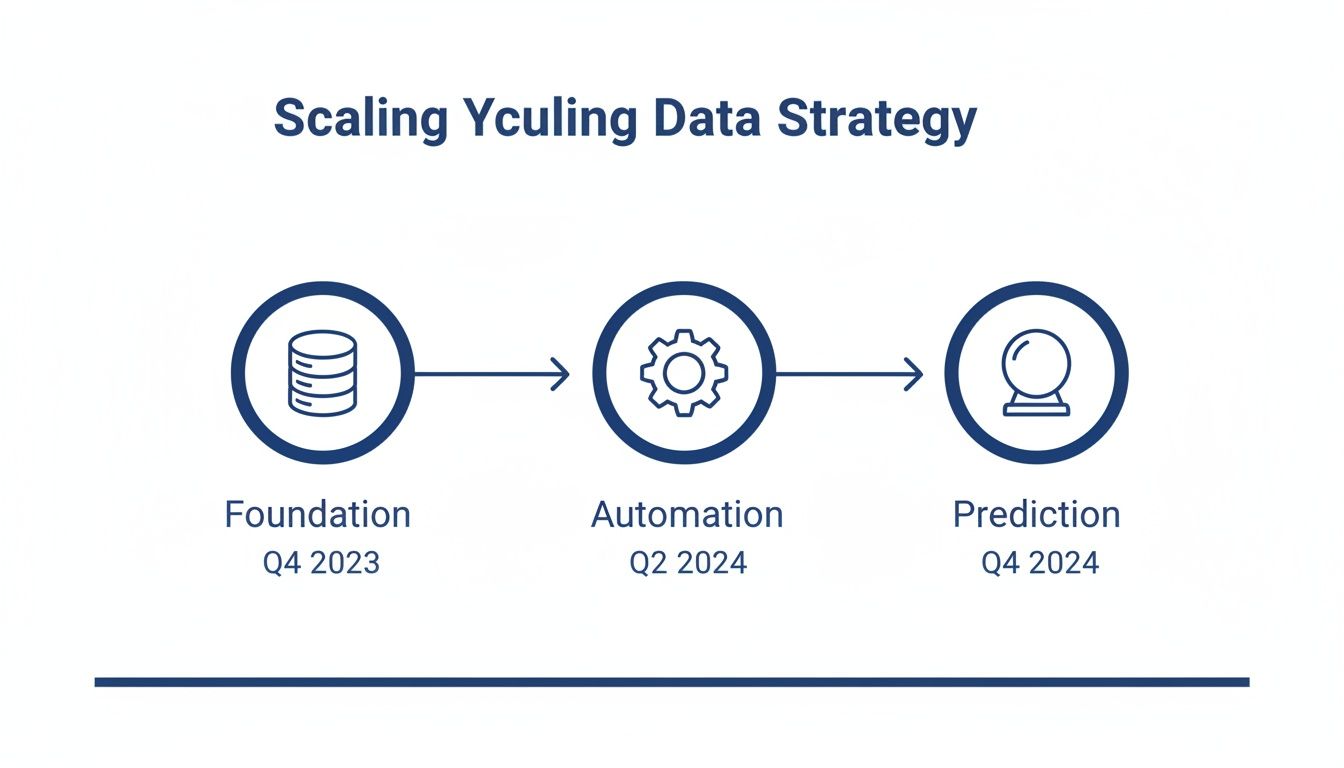
What's crucial is that each phase supports the next. You're not just completing tasks; you're building a sustainable capability that delivers compounding value.
The Stages of Data Maturity
Most businesses move through distinct phases on their path to becoming data-driven. Knowing these stages helps you set realistic goals and focus your energy where it will make the biggest difference.
This roadmap outlines the typical journey, showing the key actions, tools, and business outcomes at each step.
Data Strategy Maturity Roadmap
| Maturity Stage | Key Actions | Core Technology / Tools | Business Outcome |
|---|---|---|---|
| Data Aware | Manually pulling basic reports from separate systems like a CRM or accounting software. | Spreadsheets (Excel, Google Sheets). | Reacting to past performance, often with numbers that don't match between departments. |
| Data Proficient | Key data sources are centralised into one place. First interactive dashboards appear. | Basic Data Warehouse, ETL tools, Power BI. | A "single source of truth" exists, creating consistent, reliable business intelligence. |
| Data Savvy | Data pipelines are automated for near real-time insights. Teams use dashboards for daily decisions. | Automated ETL pipelines, advanced BI dashboards. | Proactive decisions based on current data. A culture of experimentation begins. |
| Data-Driven | Predictive models forecast outcomes. Custom solutions might be developed from data insights. | Machine Learning models, SaaS MVP development. | Strategic planning is guided by forecasts (like sales or churn). New revenue streams are created. |
This table maps out a clear progression. It's about methodically building your capabilities so that each step is solid.
The goal isn't just accurate reports. It's to create a system where data proactively guides your strategy, turning insights into a genuine competitive advantage.
Need help building your first Power BI dashboard or automating a clunky data workflow? Contact DataSimplified to see how we can turn your business data into powerful, actionable insights.
Got Questions? We've Got Answers
When businesses start thinking about data, common questions come up. Here are straight answers to the ones we hear most often.
What’s the Real Cost to Get Started With Data?
It depends, but you don't need a Silicon Valley budget. For many SMEs, getting started can be surprisingly lean.
We often begin with powerful, low-cost tools like Microsoft Power BI and basic cloud storage. The real initial investment isn’t in flashy software; it’s in the foundational data engineering—getting your scattered information cleaned, organised, and flowing into one central place. Our approach is to build a solution that delivers a high return from day one and scales as you grow, avoiding a massive upfront cost.
Our Data is a Complete Mess. Is That a Deal-Breaker?
Not at all. In fact, that's normal. Almost every business starts with data that's inconsistent or siloed.
Tackling this is the first and most critical step. We build automated data pipelines (ETL processes) that systematically clean and structure your information. This groundwork transforms what feels like a liability into your most reliable asset for decision-making.
Do I Need to Hire an Entire Team of Data Scientists?
Definitely not, at least not at the start. For most businesses, the immediate goal isn't complex predictive modelling; it's getting clear, actionable insights from the data you already have.
This is where business intelligence dashboards shine. They can be managed by a skilled consultant or an enthusiastic internal "data champion" with the right training. Data scientists typically enter the picture much later, once you've mastered the fundamentals and are ready to explore forecasting and advanced analytics.
Ready to turn your business data into your biggest advantage? Contact DataSimplified to discuss building the Power BI dashboards and data automations that will drive your growth.
