
When weighing up a data lake versus a data warehouse, it boils down to a simple question: are you trying to find answers to questions you already have, or are you exploring data to find new questions to ask?
A data warehouse is your go-to for structured, processed data, making it the engine for reliable, standardised reporting like sales dashboards. In contrast, a data lake is a vast reservoir of raw, untouched data, giving you the freedom to sift through it and uncover patterns you never knew existed.
Data Lake vs Data Warehouse: Answering The Core Question
For a small to mid-sized business, grasping this difference is the first step toward a solid data strategy. This isn't about which technology is "better"—it's about which one aligns with your business goals. One gives you dependable, historical reports, while the other is a sandbox for future-focused discovery.
Think of a data warehouse as a meticulously organised library. Every book (your data) is catalogued, placed on a specific shelf, and ready for readers (your business users) to find precisely what they need, fast. This structure is the bedrock of consistent business intelligence.
A data lake, on the other hand, is more like a massive archive. It holds everything from scribbled notes to formal reports in their original format. It demands more skill to navigate, but the potential for uncovering unique insights is enormous.

Core Differences At A Glance
This table cuts through the noise and lays out the fundamental distinctions every business leader should understand before committing to a solution.
| Attribute | Data Warehouse | Data Lake |
|---|---|---|
| Primary Users | Business analysts, managers, executives | Data scientists, data engineers |
| Data Structure | Highly structured and processed | Raw, unstructured, semi-structured |
| Core Purpose | Business intelligence and reporting | Exploratory analysis and machine learning |
| Data Processing | Schema-on-write (structure before loading) | Schema-on-read (structure when needed) |
| Typical Use Case | Creating Power BI sales dashboards | Analysing website clickstream data |
| Agility | Less flexible, more rigid structure | Highly agile and easily adaptable |
A data warehouse is built for performance and consistency, which is why it remains the cornerstone of most business intelligence operations. A data lake is built for flexibility and scale, making it the perfect foundation for advanced analytics. As businesses grow, many find they don't have to choose—they need both.
Need help building your next Power BI dashboard or data automation workflow? Contact DataSimplified to discuss how we can turn your business data into powerful insights.
Understanding The Architectural Divide
The real difference between a data lake and a data warehouse isn't just what they store, but how. This architectural decision shapes everything—from flexibility and cost to the business questions you can ask of your data. It all comes down to one question: when do you apply structure?
A data warehouse is built on a schema-on-write model. This means data must be cleaned, structured, and organised according to a predefined blueprint before it's allowed in. It’s like a chef meticulously preparing all ingredients before cooking begins; everything is ready for a specific recipe.
This upfront work is why data warehouses are the foundation of reliable business intelligence. The data is already polished and query-ready, which means your Power BI dashboards and financial reports get fast, consistent results. We cover this concept more deeply in our guide on what data warehousing is.

The Schema-On-Write Approach
The schema-on-write model is deliberate and methodical. Data is put through a classic ETL (Extract, Transform, Load) process, where it's validated and formatted.
- High Data Quality: Because every piece of data is cleaned before it lands, the warehouse becomes a highly reliable single source of truth.
- Optimised for Speed: The predefined structure makes for incredibly fast queries, a must-have for any interactive dashboard.
- Built for Business Users: This approach is designed for business analysts and managers who need dependable answers to well-understood business questions.
The real value of a data warehouse is its predictability. When your executive team looks at a sales report, they can trust the numbers because the data has already been vetted and organised for that purpose. For a South African logistics company, this means daily delivery metrics are structured into neat tables before they hit the warehouse, ensuring their Power BI dashboards are always spot-on for operational planning.
The Schema-On-Read Approach
A data lake uses a schema-on-read model. It takes in massive volumes of raw data in its original format, without forcing any structure on it first. Imagine a workshop where you store every raw material, only deciding what to do with it when a new project begins.
This approach offers incredible flexibility and keeps storage costs down. You only apply structure when an analyst pulls the data for a specific analysis. The rise of this model is a major shift. In South Africa, the data lake market reached USD 31.2 million in revenue in 2023 and is on track to hit USD 111.3 million by 2030, a response to the explosion of unstructured data that traditional warehouses can't handle. You can dig into the drivers behind these trends in this research paper.
For instance, a local e-commerce business can store raw website clickstream data, customer reviews, and social media comments in its data lake. Later, this raw information can be sifted through to uncover customer behaviour patterns or predict new buying trends—the kind of exploratory work a rigid warehouse structure would prevent.
Need help designing the right data architecture for your business? Contact DataSimplified for expert guidance on building powerful data solutions.
How Data Enters Each System
The way data enters your storage system defines what you can do with it. In the data lake versus data warehouse debate, this initial process is a key differentiator, influencing report reliability and your ability to perform deep analysis. It comes down to two philosophies: ETL and ELT.
A data warehouse relies on the time-tested ETL (Extract, Transform, Load) model. First, data is pulled from its sources. Next, it’s rigorously reshaped to fit a predefined structure. Only then is it loaded into the warehouse. This upfront transformation acts as a quality control gate, ensuring every piece of data is cleaned, validated, and aligned with a rigid schema before analysis.

The Structured Path of ETL
The ETL process drives trustworthy business intelligence. Its structured nature serves one primary purpose: delivering speed and reliability for reporting on known business metrics. This is why it remains the gold standard for financial reporting and operational dashboards where accuracy is non-negotiable.
Here’s how it works for a mid-sized South African retailer:
- Extract: Pull daily sales data from POS systems, stock levels from inventory apps, and staff hours from the HR platform.
- Transform: The data is cleansed by removing duplicates, standardising product codes, and calculating profit margins for each transaction.
- Load: This structured, analysis-ready data is loaded into the data warehouse for the finance team's weekly sales reports.
This methodical approach makes the data warehouse a bastion of consistency. The trade-off is a lack of agility, as changes to the data structure require modifying the transformation logic. You can get a deeper look at how these systems connect in our overview of what data integration involves.
The Flexible Flow of ELT
Data lakes use an ELT (Extract, Load, Transform) process. Raw data is extracted and immediately loaded into the data lake with almost no alteration. It arrives in its native format, whether that’s structured transaction logs, semi-structured JSON files, or unstructured text from customer emails. The transformation happens later, on an as-needed basis when an analyst queries the data for a specific project.
With ELT, the goal is to capture everything first and ask questions later. This preserves the original, unfiltered data, providing a rich resource for deep dives and machine learning models. This flexibility is crucial for handling modern data sources like the information from complex Internet of Things (IoT) applications development. An agricultural business in the Western Cape, for example, could load raw sensor data from its fields directly into a data lake to analyse soil moisture and weather patterns, without needing a rigid structure upfront.
Choosing between ETL and ELT is a strategic decision. ETL delivers the clean, reliable data needed for operational reporting in a warehouse. In contrast, ELT provides the raw, flexible material that fuels the exploratory work data lakes are built for.
Need help building a robust data ingestion pipeline for your business? Contact DataSimplified to discuss your data engineering needs.
A Practical Comparison Of Cost And Performance
For any business, the choice between a data lake and a data warehouse involves a trade-off: cost versus performance and flexibility. Getting this decision right affects your budget, your team's ability to get answers, and your long-term growth. Each model offers a different value proposition tailored to specific business priorities.
Data lakes are built for low-cost storage on a massive scale. They typically use inexpensive commodity hardware or cloud object storage, making them cheaper for hoarding vast amounts of raw data. Data warehouses, on the other hand, demand more expensive, high-performance hardware for storage and compute to deliver the fast query responses users expect from interactive dashboards.
The Storage Cost Divide
The fundamental cost difference starts with the storage itself. A data lake’s "store everything now, figure it out later" mindset is only affordable because of its low-cost foundation. This makes it perfect for archiving historical data or capturing unstructured information like customer support chats without blowing the budget.
In contrast, a data warehouse is a direct investment in speed and reliability. Higher storage costs are a consequence of using optimised systems tuned for rapid data retrieval. That infrastructure is what ensures your critical Power BI reports load in seconds.
This plays out in our local market. The South Africa data centre storage market is projected to expand from USD 514.38 million in 2025 to USD 894.43 million by 2030, a clear sign of escalating data demands. Within this trend, data lakes capitalise on cost-effective storage, while warehouses occupy the premium, high-performance end. You can dig deeper into these market dynamics in the full report.
Performance Expectations And Reality
These two systems are designed for different jobs. A data warehouse is optimised for blistering speed and predictable results on structured data. It’s brilliant at answering known business questions efficiently. When your sales director filters a Power BI dashboard by region, they expect an immediate response. The data warehouse's architecture is engineered to deliver that sub-second performance.
Queries against a data lake can be slower and are better suited for deep, exploratory analysis. A data scientist might happily spend hours running complex queries on raw data to uncover new patterns. In that scenario, the time to insight is more important than raw query speed. To manage the financial side, it’s wise to explore effective cloud cost optimization strategies which can reduce operational expenses for either system.
A Scalable Approach For Growing Businesses
For many South African SMEs, the most sensible path isn't an "either/or" choice but a strategic progression. It often makes sense to start with a data warehouse to establish core business metrics and deliver immediate value with essential Power BI dashboards. Later, as analytical ambitions mature, you can introduce a data lake. This gives your team the freedom to explore new opportunities without bogging down core reporting systems.
This hybrid model creates a powerful and cost-effective data ecosystem that scales with your business:
- Start with a Warehouse: Focus on structured data to get reliable, daily business intelligence running.
- Add a Lake as You Grow: Bring in raw, unstructured data for advanced analytics and machine learning projects.
- Integrate Both: Use insights from the lake to enrich the data in your warehouse, making core reports smarter.
This phased approach helps you manage costs while progressively building enterprise-level data capabilities.
Need help architecting a cost-effective data solution for your business? Contact DataSimplified to explore your options.
Matching The Right Tool To The Right Job
Let's get practical. When it comes to data lakes and data warehouses, the best choice depends on the job you need to get done. One is built for structured, high-speed reporting; the other is designed for sprawling, open-ended discovery.
For most businesses starting their data journey, the first priority is getting a firm grip on daily operations with reliable metrics. This is where a data warehouse excels, providing a stable, high-performance foundation for business intelligence that delivers immediate value. A data lake is where you go to ask bigger, more speculative questions about future trends or hidden customer behaviours.
The Data Warehouse In Action
A data warehouse is the clear winner when your business questions are well-defined, your data is structured, and you need answers fast. It's the engine powering your most critical operational dashboards.
Here are two practical South African examples:
- Manufacturing Firm: A factory in Gauteng needs to track daily production output, machine downtime, and quality control metrics. This structured data flows into a warehouse, giving managers a real-time view on their Power BI dashboards to make instant adjustments.
- Financial Services Provider: A Cape Town-based investment firm must produce strict compliance reports. Data from various trading and client systems is cleaned, standardised, and loaded into a warehouse, ensuring every report is accurate, auditable, and consistent.
In both scenarios, the goal isn't exploration—it's getting fast, reliable answers to known questions. The rigid structure of the data warehouse guarantees that performance and accuracy.
The Data Lake At Work
A data lake shines when you're dealing with unstructured data, running complex analyses, and trying to uncover patterns you didn't know existed. It’s a forward-looking tool for innovation.
Consider these situations where a data lake is a better fit:
- E-commerce Company: A growing online retailer wants to map the entire customer journey. It collects raw data—website clickstreams, social media comments, chatbot transcripts—in a data lake. Data scientists can then sift through this information to understand user paths and build personalised marketing campaigns.
- Logistics Company: A national logistics business archives raw GPS data from its fleet. This massive dataset is used to analyse route efficiency, predict traffic patterns, and optimise fuel consumption.
These use cases involve analysing data that would be impossible to cram into a traditional warehouse. The data lake’s flexibility is its core strength. We're seeing this trend accelerate locally; South African enterprises are turning to data lakes to manage the flood of unstructured data. The country's cloud data centre market has now hit USD 2.2 billion, driven by sectors that need the kind of scalable storage a data lake provides. You can dig deeper into these data platform adoption trends in this report.
The fundamental difference is this: a warehouse is optimised to report on what has already happened, while a lake is designed to help you discover what could happen next. These two systems aren't mutually exclusive; they often work brilliantly together to create a powerful data ecosystem. This hybrid approach gives a business the best of both worlds: reliable reporting and deep analytical capabilities.
Need help deciding which data architecture is right for your business? Contact DataSimplified to discuss how we can build a solution that fits your goals.
A Decision Framework For Your Business
Choosing between a data lake and a data warehouse is a strategic decision that will shape your company's data capabilities. To get it right, focus on your business objectives, available resources, and long-term vision. This framework can help guide your process.
Start With Your Business Outcomes
Before considering platforms, be clear about what you want to achieve. Are you after solid, daily operational reports? Or are you hunting for hidden patterns that could unlock new revenue streams?
- For Defined Reporting: If your main goal is to build consistent sales dashboards, track KPIs, or produce accurate financial reports, a data warehouse is almost always the best place to start. Its structure is engineered for speed and reliability.
- For Exploratory Analysis: If you want to sift through raw customer feedback, predict future trends from messy data, or train machine learning models, you'll need the flexibility of a data lake.
This decision tree helps visualise the choice. It boils down to whether you need structured reports or a sandbox for research.
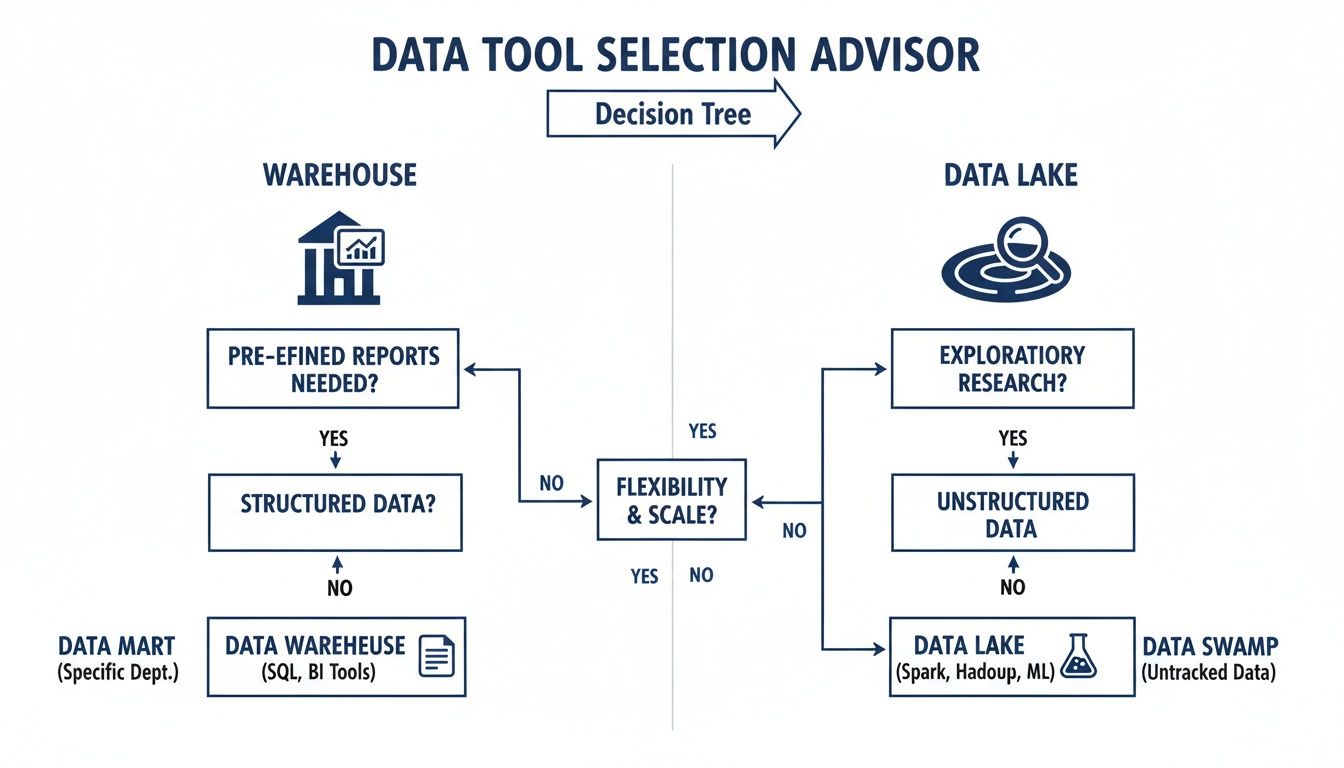
The nature of your end goal—standardised reporting versus open-ended exploration—is the single most critical factor in this decision.
Consider Your Data and Users
Next, look at the data itself and the people who will use it.
Who are your main users? Business analysts and managers use tools like Power BI and need clean, structured, and reliable data. They thrive in a data warehouse environment. In contrast, data scientists and engineers need access to raw, unaltered data to build and test complex models, which makes a data lake their natural habitat.
What does your data look like? If your business primarily runs on structured data from ERP or CRM systems, a warehouse is a perfect fit. But if you're collecting a mix of structured sales figures, web logs, and unstructured social media comments, a data lake is better equipped to handle that variety.
The Rise of The Data Lakehouse
The choice is no longer a rigid "either/or" scenario. A modern, hybrid approach called the data lakehouse has emerged, combining the low-cost, flexible storage of a data lake with the powerful data management features and performance of a data warehouse. A lakehouse architecture offers a single, unified platform for both business intelligence and data science, eliminating data silos and reducing complexity.
This model lets you store all your data—structured, semi-structured, and unstructured—in one place. Your business analysts can run high-performance queries for their Power BI dashboards, while your data scientists can work with the raw data for their projects, all from the same source. To make this work, strong data governance is non-negotiable. For a deeper dive, you can explore our practical guide to building a data governance framework.
Ultimately, the best data architecture is the one that directly supports your business strategy. Whether that's a warehouse for immediate insights, a lake for future discovery, or a lakehouse for the best of both worlds, the right choice will empower your team to turn data into a competitive advantage.
Need help building your data strategy or next Power BI dashboard? Contact DataSimplified to discuss how we can turn your business data into powerful insights.
Frequently Asked Questions
Here are quick, practical answers to common questions business leaders ask when weighing a data lake against a data warehouse.
Can a Small Business Use Both a Data Lake and a Warehouse?
Yes. In fact, a hybrid model is often a smart, scalable strategy for growing businesses.
Most SMEs we work with start with a data warehouse to get their core business intelligence in order—think essential sales and financial dashboards in Power BI. This approach delivers immediate, tangible value by providing reliable reports for daily decisions.
Later, as the business matures and collects more varied data, adding a data lake makes perfect sense. It becomes the environment for more complex analysis, like digging into customer behaviour or building predictive models, without slowing down the core reporting system. This staged approach keeps costs manageable while building future capabilities.
Which Is Better for Power BI Dashboards?
For the interactive dashboards most businesses build in Power BI, a data warehouse is the better choice. Its design is geared towards serving up clean, structured, and optimised data, which is exactly what you need for fast, accurate, and reliable reports. When executives look at a dashboard, they need to trust the numbers, and the warehouse’s "schema-on-write" model locks in that data integrity.
You can technically connect Power BI to a data lake, but in nearly every real-world scenario, you would first process that raw data through an ETL pipeline and load it into a data warehouse to guarantee the performance and consistency everyone expects from their BI tools.
What Is a Data Lakehouse and Do I Need One?
A data lakehouse is a modern architecture that aims to provide the best of both worlds. It blends the cheap, flexible storage of a data lake with the powerful management features and speed of a data warehouse, all in one system. The main goal is to eliminate the need to manage two separate, complex systems.
For a growing SME, a lakehouse can be a compelling, future-proof option. It provides a central place to manage all your data—structured, semi-structured, and unstructured. This simplifies governance and lets your business analysts and data scientists work from a single source of truth, creating a more unified and efficient data strategy.
Need help deciding on the right data architecture or getting your next Power BI dashboard built? Contact DataSimplified to discuss how we can turn your business data into a competitive advantage.
