
Choosing the right IT consulting partner is a critical decision. While McKinsey IT consulting offers world-class strategic direction for massive corporate overhauls, their model isn’t designed for every company. Small and mid-sized South African businesses often need a partner who delivers tangible results—quickly and without an enterprise-level price tag.

This guide compares the high-level strategic approach of a global firm with the hands-on execution of a specialist data partner, helping you decide which is right for your business.
Global Strategy vs. Specialist Execution
When choosing an IT partner, clarify your objective. Do you need a high-level strategic roadmap, or a technical team to build and implement a specific solution? This is the fundamental difference between a global giant like McKinsey and a specialist partner. For a detailed guide, see our article on how to choose the right data services outsourcing partner for your business.
Global strategy consultants are masters of the "what" and the "why." They are brought in to analyse markets, restructure organisations, and map out long-term digital transformations. The resource, Strategic IT Consulting Services: The CEO’s Guide, provides a great overview of this C-suite-level advice.
In contrast, specialist partners focus on the "how." They bring deep, focused expertise in areas like data engineering, Power BI dashboards, and SaaS MVP development to bring a clear vision to life.
McKinsey vs. Specialist Partner At a Glance
You hire one for the blueprint and the other to build the house. The table below breaks down the key differences.
| Attribute | McKinsey IT Consulting | Specialist Data Partner (e.g., DataSimplified) |
|---|---|---|
| Primary Focus | High-level corporate and digital strategy, C-suite advisory, market analysis, and organisational transformation. | Technical execution, project implementation, and hands-on development of data and software solutions. |
| Ideal Client | Large enterprises and corporations facing complex, multi-year strategic challenges. | Small to mid-sized businesses needing functional data pipelines, dashboards, or SaaS applications. |
| Core Deliverable | Strategic roadmaps, analytical reports, competitive intelligence, and transformation blueprints. | Functional Power BI dashboards, automated ETL workflows, and working SaaS MVPs. |
| Cost Structure | Premium, often retainer-based, reflecting global brand value and extensive research capabilities. | Value-focused, typically project-based or milestone-driven, prioritising efficient delivery of results. |
Your choice depends on your needs. A global firm provides the 30,000-foot view, while a specialist partner delivers practical, working solutions.
Strategic Vision vs. Technical Execution
Understanding the difference between high-level strategic advice and hands-on technical delivery is crucial. It shapes the entire project, from the first conversation to the final handover. One partner helps you draw the map; the other builds the road.
A global powerhouse like McKinsey operates at the 30,000-foot view, where corporate strategy meets technology. Their teams advise CEOs and boards on massive digital transformations, market entry, and overhauling organisational structures. It’s a research-heavy, analytical approach designed to produce strategic roadmaps for navigating complex, enterprise-wide problems.
A specialist firm like DataSimplified focuses on practical, on-the-ground execution of data projects. Our model is geared towards agile implementation and deep technical skill to deliver solutions that work.
The Focus of Engagement
A McKinsey IT consulting project answers the "what" and the "why." They analyse market trends, spot competitive risks, and create frameworks that tie big tech investments to long-term business objectives. Their deliverables are typically exhaustive reports, strategic blueprints, and financial models that give executives the confidence to make massive decisions.
A specialist partner is brought in to figure out the "how." Our work often picks up where a strategy document leaves off. We focus on tangible outcomes, such as:
- Data Engineering: Building solid ETL (Extract, Transform, Load) pipelines to move data from scattered sources into a clean, usable data warehouse.
- Business Intelligence: Creating interactive Power BI dashboards that give operations managers the real-time information they need.
- SaaS MVP Development: Building a functional, market-ready minimum viable product for a new software idea.
A strategist helps you decide if you need a bridge or a tunnel. An execution specialist pours the concrete and lays the asphalt. Both are necessary, but they solve different problems.
Impact on Project Scope and Deliverables
This difference in focus directly impacts project scope. A McKinsey engagement could involve multiple business units over several months, ending in a boardroom presentation outlining a five-year digital plan. It’s about charting a new course for the whole company.
Our projects are more contained and results-driven. The aim isn't just to advise; it's to build. A typical project might be creating a data automation workflow that cuts manual reporting time by 90%, or launching a SaaS platform to sign up its first paying customers. When choosing a partner, check their experience with modern approaches, like optimizing customer experience with AI in SaaS. You can see our specific offerings in our guide to analytics and consulting services.
This push for tangible results reflects a broader trend. The South African management consulting market, valued at USD 1.89 billion, is dominated by operations consulting, where businesses demand real productivity gains. Clients want partners who can see a project through from idea to implementation.
In the end, your choice boils down to a simple question: do you need someone to draw a new map, or a team of builders to start working on the map you already have?
Comparing Engagement Models and Cost
The day-to-day experience of working with a global firm versus a specialist partner is vastly different. This shapes your budget, timeline, and the level of hands-on involvement you can expect.
A McKinsey IT consulting engagement is typically a long-term, retainer-based affair. These are multi-month or even multi-year strategic overhauls designed to solve massive organisational puzzles. Their model involves embedding a full team of consultants into your business for a deep, analytical dive.
A specialist partner like DataSimplified operates on project-based, milestone-driven work. Our engagements are tightly scoped around specific, measurable results. This approach is built for speed and efficiency, focused on delivering a working solution within a set timeframe and budget.
The Structure of a Consulting Team
The team composition also differs. McKinsey provides a structured hierarchy: a partner, an engagement manager, and several junior analysts. While brilliant, much of the day-to-day work is often handled by younger consultants under senior guidance.
With a specialist firm, you work directly with the experts building your solution. The team is lean, comprising seasoned data engineers, Power BI developers, or SaaS architects. This hands-on involvement from senior practitioners means less ramp-up time and more focus on getting the job done. Communication is direct, and technical questions are answered by the person writing the code.
Comparing Communication and Cadence
The project rhythm also feels different.
- McKinsey: Communication is formal and structured, with weekly steering committee meetings, detailed progress reports, and major presentations at key milestones. The goal is to keep executive sponsors aligned with the high-level strategic direction.
- Specialist Partner: Communication is more frequent, agile, and often informal. We use daily or weekly check-ins, shared project management tools, and direct messaging to stay aligned. This constant communication allows for quick adjustments and collaborative problem-solving.
For a mid-sized business that needs to move fast, this is a significant advantage. The agile model cuts out the lengthy feedback loops common in large corporate projects, enabling a more responsive partnership.
The real cost of a project isn't just the invoice. It's the time your team spends managing the engagement. An efficient, project-based model delivers value much faster—a critical advantage for a growing business.
Analysing the Cost Structures
The most obvious difference is cost. A name like McKinsey commands a premium fee, reflecting their global brand and research capabilities. Engagements can easily run into millions of Rands, placing them within reach of only the largest corporations. It's an investment in top-tier, board-level direction.
A specialist partner provides a value-focused pricing model. With lower overheads and lean teams, we deliver deep technical expertise at a fraction of the cost. Pricing is transparent and tied directly to project deliverables, whether that's a new set of Power BI dashboards or a SaaS MVP.
This model gives you a clear, predictable return on investment. For South African SMEs, this is often the only practical way to access enterprise-level data engineering and business intelligence expertise. Learn more in our guide on why outsourcing data services internationally can unlock efficiency. A value-driven approach ensures you’re paying for tangible outcomes, not just a presentation deck.
Strategy vs. Execution: Where Do You Need Help?
Hiring an IT consulting partner means buying a specific set of skills. The key question is: do you need a team that thinks at 30,000 feet, or one with its hands on the keyboard? This is the fundamental difference between McKinsey’s strategic muscle and a specialist’s technical firepower.
A McKinsey IT consulting team tackles the big "what" and "why" questions. They provide world-class strategic frameworks, exhaustive market analysis, and deep competitive intelligence. They deliver the clarity needed to justify major tech investments or enter new markets. What they deliver is intellectual capital—the blueprints and roadmaps that guide boardroom decisions.
A specialist firm like DataSimplified is built to deliver the "how." Our value is in applying technical skills to solve real-world business problems. We turn that boardroom vision into a functioning reality.
The Strategist's Playbook: Thinking Big
McKinsey’s consultants deconstruct complex business challenges from a bird's-eye view. Their capabilities are intentionally broad, focusing on the intersection where business performance meets technology.
Their strategic input usually looks like this:
- Market Opportunity Analysis: Pinpointing new revenue streams or markets that technology can unlock.
- Digital Transformation Roadmaps: Crafting multi-year plans to move a business beyond legacy systems.
- Competitive Benchmarking: Sizing up your tech stack against industry leaders.
- Operating Model Design: Rethinking how IT departments and workflows are structured.
Their work provides the crucial direction needed before committing millions to a technology project. They set the course.
The Specialist's Toolkit: Getting It Done
While the strategist points to the destination, the technical specialist builds the vehicle. Our skillset is deep, focused, and execution-oriented. We apply data and software to create tangible business value, fast.
Our core technical skills include:
- Data Engineering: We design and build robust ETL (Extract, Transform, Load) processes and data warehouses. This foundational plumbing ensures your data is clean, reliable, and ready for analysis.
- Business Intelligence (BI): We develop interactive Power BI dashboards that translate raw data into clear, actionable insights for your teams.
- Data Automation: We build automated workflows to eliminate manual data handling, freeing up your people for more valuable work.
- SaaS MVP Development: We build and launch functional, market-ready Minimum Viable Products for new software ideas, helping you test your concept without breaking the bank.
This hands-on expertise is what businesses need when they already know what they want to achieve and just need a partner to build it right.
McKinsey provides the architectural drawings for a new factory. A specialist partner brings the engineers and tools to pour the foundation and install the machinery. You can't operate one without the other.
This demand for practical implementation is driving local growth. The IT Consulting & Implementation market in South Africa is set to hit US$343.84 million in revenue, powered by the need for real-world digital solutions. The underlying need for builders has never been clearer. You can learn more about the growth of the South African IT consulting market.
Knowing When to Pass the Baton
Successful projects understand the hand-off point where strategy ends and implementation begins. A strategic roadmap from a firm like McKinsey is valuable, but it’s just a document until a technical team turns it into code and working systems.
If you’re asking, "What should our digital strategy be for the next five years?", a global strategist is your first call. But if your question is, "How do we build a Power BI dashboard to track our sales performance in real-time?", you need a technical specialist.
Often, a hybrid approach is smartest. A business might engage McKinsey for high-level strategy and then bring in a specialist like DataSimplified to execute the data and analytics workstreams outlined in that plan.
When to Choose McKinsey vs. a Specialist Partner
To see how these consulting models play out, let's look at three common business scenarios in the South African market. This will clarify when to use a global strategist versus a specialist partner.
Each situation highlights a different business need, drawing a clear line between high-level strategy and focused technical execution.
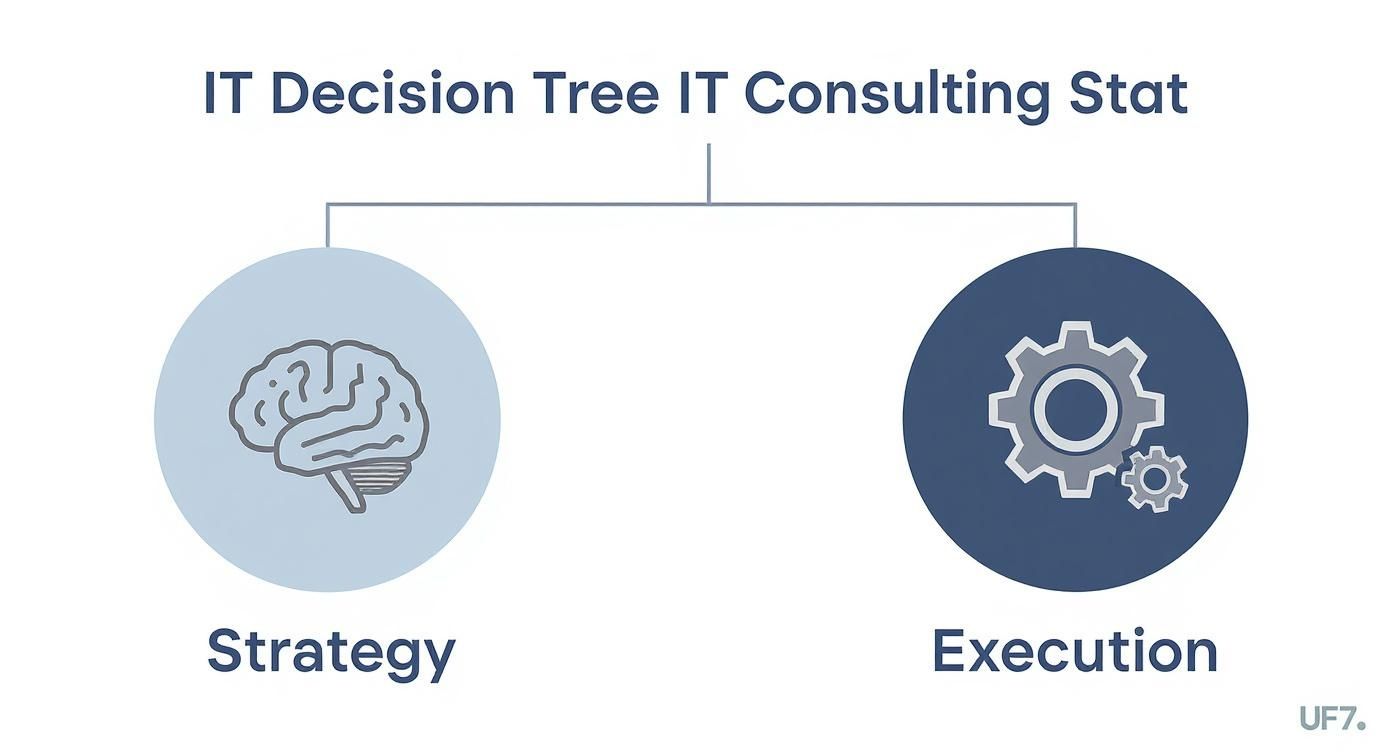
The key takeaway is that your starting point—whether you need to figure out what to do or just need someone to do it—is the biggest factor in deciding who to call.
Scenario 1: The Multi-Year Digital Transformation
Imagine a major financial services firm in Johannesburg. They face pressure from fintech startups and need to overhaul legacy systems, rethink the customer experience, and find new digital revenue streams. The board has approved a massive transformation budget, but there is no unified roadmap.
This is classic McKinsey IT consulting territory. Their job isn't to code the new banking app but to answer foundational strategic questions. They would conduct market analysis, benchmark the bank against global leaders, and craft a detailed blueprint for the entire transformation.
Their deliverable would be a comprehensive strategic plan that aligns the C-suite, maps out investment priorities, and projects financial impact. In a high-stakes market like African fintech, this is non-negotiable. You can read more about the growth of the African fintech market to grasp the scale.
For enterprise-wide change involving restructuring and multi-million rand technology bets, the strategic validation of a global firm is essential.
Scenario 2: The Mid-Sized Data Execution Project
Now, consider a mid-sized logistics company in Durban. Their problem is operational, not strategic. They have data trapped in different systems, making real-time performance tracking impossible. Their goal is specific: automate data extraction and build Power BI dashboards to monitor delivery times, fuel consumption, and warehouse capacity.
This is a perfect job for a specialist partner like DataSimplified. The company needs a sharp technical team for a well-defined project. A specialist brings the exact skills required:
- Data Engineering: Building data pipelines (ETL processes) to consolidate information from multiple sources.
- Business Intelligence: Designing and building the Power BI dashboards that give managers instant visibility.
- Data Automation: Setting up workflows to eliminate manual reporting and reduce human error.
The engagement is project-based, with clear milestones and a focus on delivering a working solution quickly. The outcome is a functional tool that improves operational efficiency from day one.
Scenario 3: The Hybrid Implementation Model
Finally, consider an established national retailer. They previously hired a large firm to create a sweeping digital strategy. The plan is solid and includes using customer data for personalised marketing. The problem? Their in-house IT team lacks the specialized data engineering and analytics skills to build it.
This is where a hybrid approach makes sense. The strategic "why" and "what" are defined. Now they need an execution partner for the technical "how."
A specialist firm can take that strategic roadmap and bring it to life. This means building the necessary data infrastructure, developing analytical models, and creating the reporting dashboards the plan requires. This model pairs high-level strategic direction with agile, cost-effective technical implementation, ensuring the initial investment in strategy delivers a tangible return.
Making the Right Choice for Your Business
Choosing the right partner requires a clear look at your company's immediate needs. First, determine if you are solving a strategic problem or an execution problem. The answer will point you to the right type of consultant.
Be honest about your internal resources, budget, and desired outcomes. Global firms and specialist partners operate in different spheres for a reason; one provides the map, while the other provides the tools and hands-on expertise to build the road.
A Practical Checklist for Self-Assessment
Before making a call, work through these questions with your leadership team.
- Strategy vs. Execution: Is your challenge figuring out what to do next, or getting a defined project over the line? If you need a five-year digital blueprint, McKinsey IT consulting is built for that. If you need a Power BI dashboard built next quarter, a specialist is your best bet.
- Budget and ROI: What is your budget, and how quickly do you need a return? A multi-million rand engagement is a long-term investment in strategic direction. A project with a specialist is a tactical investment where you should see measurable results in months, not years.
- Internal Capacity: Does your team have the skills to implement a strategic plan? A brilliant strategy is useless if it gathers dust. Be realistic about whether you need a partner to advise or one who can handle the hands-on data engineering and development.
- Required Expertise: Do you need broad market analysis or deep expertise in a tool like Power BI or a process like ETL automation? Strategists are masters of the big picture, while specialists live and breathe technical details.
The Final Takeaway
The choice between a giant like McKinsey and a specialist firm like DataSimplified is simple when you focus on your core need.
McKinsey is the premier choice for defining complex, enterprise-level strategy. A specialist partner excels at implementing tangible, data-driven solutions with speed and technical precision, delivering immediate business value.
For South African SMEs and mid-market companies, this distinction is key. If your goal is to build a SaaS MVP, automate a manual data workflow, or turn raw data into actionable Power BI dashboards, a specialist partner offers the most direct and cost-effective path to success.
Need help building your next Power BI dashboard or data automation workflow?
Contact DataSimplified to discuss how we can turn your business data into powerful insights.
Frequently Asked Questions
Choosing between a global giant and a specialist partner brings up many questions. Here are answers to the most common ones.
How do the costs of McKinsey IT consulting compare to a specialist?
The price difference is significant. An engagement with McKinsey IT consulting is a major financial commitment, often costing millions of Rands. You are paying a premium for the brand, their deep research resources, and access to C-suite-level strategic thinking.
A specialist partner like DataSimplified offers a value-driven, project-based model. Costs are transparently linked to deliverables, such as building a Power BI dashboard or an ETL pipeline. This makes high-level technical skills accessible for small and mid-sized businesses at a fraction of the cost.
Can a small business hire McKinsey?
Theoretically, yes, but it is rare. McKinsey’s model is built for large corporations tackling complex, multi-million rand problems that justify their fees. Their methods are not designed for the fast-moving, budget-conscious reality of a typical South African SME.
For smaller businesses, a specialist is a more practical choice. You get the precise technical skills you need—like data engineering or SaaS MVP development—without the massive overhead of a global consultancy. It is about getting a direct, measurable return on your investment.
The best consulting partnerships happen when the scale of the consultant matches the scale of the problem. A specialist brings the focused, hands-on support growing businesses need to get projects done right.
When is the right time to move from a strategist to an implementer?
The handover point is when the "what" and "why" are clear, and you need someone to manage the "how." A strategic roadmap from a firm like McKinsey provides high-level direction. Once the board approves that plan, you need a technical team to make it a reality.
That is the perfect moment to engage a specialist partner. They can take the strategic blueprint and execute the technical components—building the data warehouse, developing analytics models, or launching the SaaS application. This hybrid approach leverages the strengths of both, ensuring your strategic investment turns into tangible results.
Need help building your next Power BI dashboard or data automation workflow?
Contact DataSimplified to discuss how we can turn your business data into powerful insights.
