
Data governance is the framework for managing your company's data as a strategic asset. It's a set of rules and processes defining who can take what action, with what data, and when. The goal is to ensure that from your sales team to your leadership, everyone works with information that's reliable, consistent, and secure.
What Is Data Governance in Simple Terms?
For many business owners, "data governance" sounds like a complex IT problem for large corporations. This is a common misconception. At its core, data governance is a practical business discipline that prevents the data chaos leading to poor decisions and operational headaches.
Imagine trying to run a professional kitchen without rules. Chefs would use inconsistent ingredients, recipes would vary, and food safety would be a risk. Data governance brings those essential rules to your company’s information, ensuring everyone can trust what they're working with.
So, What Does It Actually Do?
Data governance brings order, trust, and accountability to your data. It’s the difference between a messy stockroom where no one can find anything and a managed warehouse where every item is labelled, located, and has an owner.
Without it, you face common problems:
- Conflicting Reports: Your sales team's spreadsheet shows one number, while finance has a different figure in the accounting system. Which is correct?
- Wasted Effort: The marketing team targets customers who left months ago because the client database is out of date.
- Compliance Risks: Sensitive customer information is handled inconsistently, creating security vulnerabilities and potential POPIA fines.
Governance cuts through this noise by creating a clear, company-wide framework. While we focus on data, it’s also useful to understand the broader principles of what is information governance to see how organisations manage all digital assets.
The Four Pillars of Data Governance
To be practical, data governance can be broken down into four essential pillars. Each pillar addresses a fundamental question about how you manage data, from its raw state to its use in a Power BI dashboard. Understanding what data warehousing is provides context for how data is centralised for this purpose.
This table gives a quick overview of the components of a strong data governance framework.
The Four Pillars of Data Governance
| Pillar | What It Means in Simple Terms | Why It Matters for Your Business |
|---|---|---|
| Data Quality | Ensuring your data is accurate, complete, and consistent. | You can’t make good decisions with bad data. High-quality data prevents costly mistakes and makes operations smoother. |
| Data Stewardship | Assigning specific people in the business as "owners" of certain data sets. | This creates accountability. The people who understand the data’s business context are in charge of maintaining it. |
| Data Security | Protecting data from unauthorised access and ensuring compliance with rules like POPIA. | This builds customer trust, protects your reputation, and helps avoid significant legal penalties. |
| Metadata Management | Creating a "data dictionary" or a single source of truth that defines your data. | This ensures everyone in the business speaks the same language. "Active Customer" means the same thing to sales and finance. |
These pillars form the foundation you need. Without them, tools like ETL pipelines, automation platforms like CloverDX, and business intelligence dashboards can't deliver trustworthy value.
Need help building a practical data governance framework? Contact DataSimplified to discuss how we can turn your business data into powerful insights.
Why Governance Is a Competitive Advantage, Not an Expense
For many small and mid-sized businesses, "data governance" can feel intimidating. It often suggests expensive overhead best left to large corporations. It’s easy to view it as a cost centre, not a core business function.
This perspective misses the point.
Effective data governance isn’t an expense; it’s an investment that delivers a competitive edge. It’s the groundwork that prevents costly mistakes, boosts efficiency, and builds the customer trust that fuels growth. Without governance, your teams are constantly on the defensive, wasting time arguing over reports, cleaning messy data, or fixing errors. The real cost is hidden in those wasted hours and bad decisions made on faulty information.
From Reactive Cleanup to Proactive Strategy
Data governance shifts your business from a reactive to a proactive mindset. Instead of fixing problems after they occur, you prevent them from happening. That is where you find the true return on investment.
When everyone in the organisation trusts the data, the entire decision-making process speeds up.
Here are a few tangible benefits:
- Faster, Smarter Decisions: When your leadership can rely on the numbers in their Power BI dashboards, they can make strategic moves with confidence.
- Improved Operational Efficiency: A single, trusted source for customer or product data eliminates duplicated effort and smooths out workflows across sales, marketing, and operations.
- Reduced Compliance Risk: With governed data, complying with regulations like South Africa's POPIA (Protection of Personal Information Act) becomes a systematic process, not a last-minute panic.
By setting clear rules and defining accountability, you turn your data from a chaotic liability into a predictable, strategic asset. This is the bedrock of any successful business intelligence or data automation project.
Building Trust Inside and Out
A solid governance framework builds internal confidence and, more importantly, customer trust. How you handle personal information is a major differentiator in today's market.
Research on data sharing in sub-Saharan Africa, including South Africa, confirms that customer trust is directly tied to governance. When data privacy and ethical standards were guaranteed, the willingness of people to share data increased to 88.2%. This shows that managing data responsibly is a powerful way to build strong customer relationships. You can read the full research about data sharing trends in sub-Saharan Africa.
This trust gives you a genuine advantage. Customers who believe you will protect their information are more likely to remain loyal. Our analytics and consulting services help businesses build this kind of robust data foundation.
Investing in data governance ensures your entire operation, from sales forecasting to customer support, runs on reliable, secure, and high-quality information. It’s not about creating rules for their own sake; it’s about enabling your business to operate with precision and insight.
Building Your Data Governance Framework
A data governance framework isn't a piece of software you install and forget. It's a practical blueprint for your business—a clear set of rules, roles, and processes that guide how you handle data.
For a small or mid-sized business, you don’t need enterprise-level complexity. Focusing on a few key building blocks is the best way to make tangible progress. When used together, these components create a solid system that keeps your data reliable, secure, and ready to deliver business value.
Data Stewardship: Assigning Clear Ownership
First, you need Data Stewardship. This is about assigning clear ownership for your data. It answers the critical question: "Who is responsible for this information?"
A Data Steward isn’t necessarily from the IT department. More often, they are the people in the business who use the data daily. For example, your head of sales is the natural steward for customer relationship data, while your operations manager should own product and inventory numbers.
Assigning ownership creates accountability. When someone is officially responsible for a dataset, its quality and security become a core part of their role, ensuring the information remains accurate and useful.
Data Quality Management: Ensuring Trustworthy Information
With stewards in place, the next step is Data Quality Management. This involves ensuring your data is accurate, complete, consistent, and up-to-date. Bad data leads to bad decisions, wasted marketing spend, and operational hiccups.
Imagine a sales team working from a customer list full of duplicates, old phone numbers, and misspelled names. They spend more time cleaning records than selling. That’s a classic data quality problem.
Getting this right involves a few key activities:
- Profiling data to understand its current state and identify problems.
- Cleansing data by fixing errors, filling gaps, and merging duplicates.
- Setting rules to prevent bad data from entering your systems.
This discipline is foundational to any successful business intelligence initiative. If you want to learn more, check out our guide on improving data quality for business success.
Metadata Management: Creating a Common Language
Metadata Management sounds technical, but the concept is simple: it’s about creating a "data dictionary" for your business. Metadata is data about your data. It defines terms, explains where information came from, and describes its business context.
Without it, confusion is common. The finance team might define an "active customer" as someone who paid an invoice in the last six months, while sales defines it as anyone contacted in the last 90 days. This misalignment leads to conflicting reports and arguments.
A well-managed data dictionary ensures everyone speaks the same language. It creates a single source of truth, so when a metric appears in a Power BI dashboard, its meaning is clear.
Data Security and Compliance: Protecting Your Assets
Finally, Data Security is the component that protects your data and ensures you meet legal obligations. In South Africa, that means following the Protection of Personal Information Act (POPIA).
This goes beyond strong passwords. It means establishing clear policies on who can access, edit, or delete specific data. For instance, only HR staff should access employee salary information, and only authorised finance team members should handle sensitive payment details.
Proper security isn't just about avoiding fines; it's about building trust. When customers feel you will protect their information, they are more likely to stay. This turns compliance from a chore into a competitive advantage.
Need help building a practical data governance framework? Contact DataSimplified to discuss how we can turn your business data into powerful insights.
Defining Key Roles and Responsibilities

A common mistake is thinking data governance is just an IT job. Effective governance is a team sport that requires people from across the business with clearly defined responsibilities.
For a smaller company, this doesn't mean hiring a new team. It’s about assigning practical roles to existing staff who understand the data and its business context. Think of it like a restaurant kitchen: the head chef is accountable for the menu, while station chefs master their specific areas. Data governance works on the same principle. A successful structure typically involves three core functions.
The Data Governance Council
Your Data Governance Council is the strategic lead for your data operations. In a mid-sized business, this is likely a group of department heads—your head of sales, finance lead, and operations manager—who meet regularly to make high-level decisions.
Their primary job is to provide direction and resolve disputes. They set priorities, approve major data policies, and ensure the program has executive support. When sales and marketing can’t agree on the definition of a "qualified lead," the council has the final say. This top-down backing prevents governance from becoming just another short-lived IT project.
Data Stewards: The Business Experts
While the council handles strategy, Data Stewards are the hands-on champions of data within their departments. These are your subject matter experts—the people who understand what the data means and how it's used daily.
A Data Steward is responsible for the quality, definition, and business rules of a specific data domain. For example:
- The Finance Manager is the steward for financial data, defining "revenue" and ensuring its accuracy.
- The HR Manager acts as the steward for employee data, managing its privacy and ensuring POPIA compliance.
- The Operations Manager stewards product and inventory data, taking responsibility for its consistency.
These individuals are vital because they bridge the gap between business needs and technical implementation. Their contextual knowledge ensures data quality drives real business value. A study on Big Data governance in South Africa confirmed that managing data quality was the single most important factor for effective governance. You can discover more insights about data governance factors in South Africa.
Data Custodians: The Technical Guardians
Finally, Data Custodians are the technical guardians of your data. This role is usually filled by your IT team or a data engineering specialist. While stewards own the business definition and quality rules, custodians are responsible for the technical implementation of those rules.
They manage the databases, servers, and systems where the data lives. Their work includes managing access controls in SQL Server, performing backups, and ensuring the data infrastructure is secure. If a Data Steward decides a field must contain only numbers, the Data Custodian configures the database to enforce that rule.
They don't decide what the data policies should be, but they are responsible for ensuring the technology correctly implements the policies set by the stewards and the council.
This separation of duties puts business context in the hands of business users and technical execution in the hands of technical experts.
Data Governance Roles in Your Business
| Role | Primary Responsibility | Example Task |
|---|---|---|
| Data Governance Council | Provides strategic direction and resolves high-level data issues. | Approving the official company-wide definition of an "Active Customer." |
| Data Steward | Manages the quality, definition, and rules for a specific data domain. | Documenting the source and business rules for all sales pipeline data. |
| Data Custodian | Implements and maintains the technical systems that store and secure data. | Setting up user permissions in the database to restrict access to sensitive HR data. |
By defining these roles, you create a structure of accountability that empowers your organisation to trust and use its data with confidence.
Need help building your next Power BI dashboard or data automation workflow?
Contact DataSimplified to discuss how we can turn your business data into powerful insights.
Your Practical Roadmap to Implementation
Getting started with data governance can feel overwhelming, especially for a growing business. The secret is to start small, show value quickly, and build momentum.
This roadmap breaks the process into manageable steps for a small or mid-sized business. We'll focus on getting tangible results from the start.
Phase 1: Start Small and Define Your Scope
The biggest mistake is trying to govern all data at once. This leads to a loss of focus and stakeholder interest. A smarter approach is to pick one high-impact area and master it.
For most businesses, customer data is the perfect place to start. It’s vital for sales, marketing, and service, so improvements are felt immediately. By narrowing your focus, you make the task less daunting and the benefits easier to understand. Your goal is progress, not perfection. A simple goal like "improve the quality of our active customer list" is a great first step.
Phase 2: Secure Leadership Buy-In
Before you start, you need leadership support. Data governance often changes how people work, and that shift requires visible backing from the top. Pitch a business solution, not a technical project.
Frame the project around results they care about. Explain how a clean customer list will:
- Boost marketing ROI by reducing bounced emails.
- Make the sales team more efficient by eliminating duplicates.
- Cut operational waste by preventing shipping errors.
Connect data governance to a headache leadership already wants to solve. When they see it as a solution to a known business pain, getting their support becomes much easier.
Phase 3: Assemble Your Initial Team
You don’t need to hire a new department. Your team already exists within your business—they are the people closest to the data you’ve chosen to focus on.
Assemble a small founding governance team:
- A Business Lead: The person who feels the pain of bad data most, like the Head of Sales.
- A Data Steward: An expert from the relevant department who understands the data’s context.
- A Technical Custodian: Someone from your IT or data team who manages the systems, like your SQL Server database.
This cross-functional team provides the right mix of business insight and technical skill.
Phase 4: Develop Simple Initial Policies
Your first policies should be practical and tied to your initial scope. Start with a few clear, simple rules that address the most obvious problems.
For a customer data pilot, this might include:
- A simple definition of an "active customer."
- A basic data entry rule, like making a postal code a required field.
- A straightforward process for merging duplicate accounts.
Document these rules where everyone can access them. The goal is to create a living guide that evolves.
Phase 5: Launch a Pilot Project
Now it's time to act. A pilot project is your chance to prove that data governance delivers real value. It should be short, measurable, and visible.
A great pilot for a mid-sized business could be cleaning a customer list for a new Power BI dashboard. This project has a clear outcome. You can measure the improvement in data quality and show how it leads to more reliable reports. The success of this first pilot is your best tool for getting company-wide buy-in.
Phase 6: Measure and Communicate Success
Once your pilot is complete, measure the results and share them. Track clear metrics that show the impact. Did you reduce duplicate records by 40%? Did sales forecast accuracy improve?
Take these wins back to your leadership team. This creates a powerful feedback loop: a successful pilot proves value, which justifies more investment and allows you to expand your scope. Even Stats SA notes that the demand for high-quality data has never been stronger, showing that good governance is core to national strategy. You can learn more about their strategic approach to data governance.
By following this roadmap, you turn data governance from an abstract concept into achievable steps that deliver real business value.
Need help building your next Power BI dashboard or data automation workflow?
Contact DataSimplified to discuss how we can turn your business data into powerful insights.
Turning Data Governance Into Your Strategic Asset
Data governance is often viewed as restrictive rules or red tape. This is a misunderstanding. Think of it as the foundation that allows your business to trust its data, make smarter decisions, and innovate with confidence. It’s what turns data from a liability into a competitive advantage.
For any South African business serious about data, a solid governance strategy is non-negotiable. It’s what ensures the information feeding your Power BI dashboards is reliable. It's the difference between your business intelligence delivering actionable insights versus pretty charts based on guesswork. Without it, your data automation workflows are built on shaky ground.
This simple roadmap provides a practical way to get started.
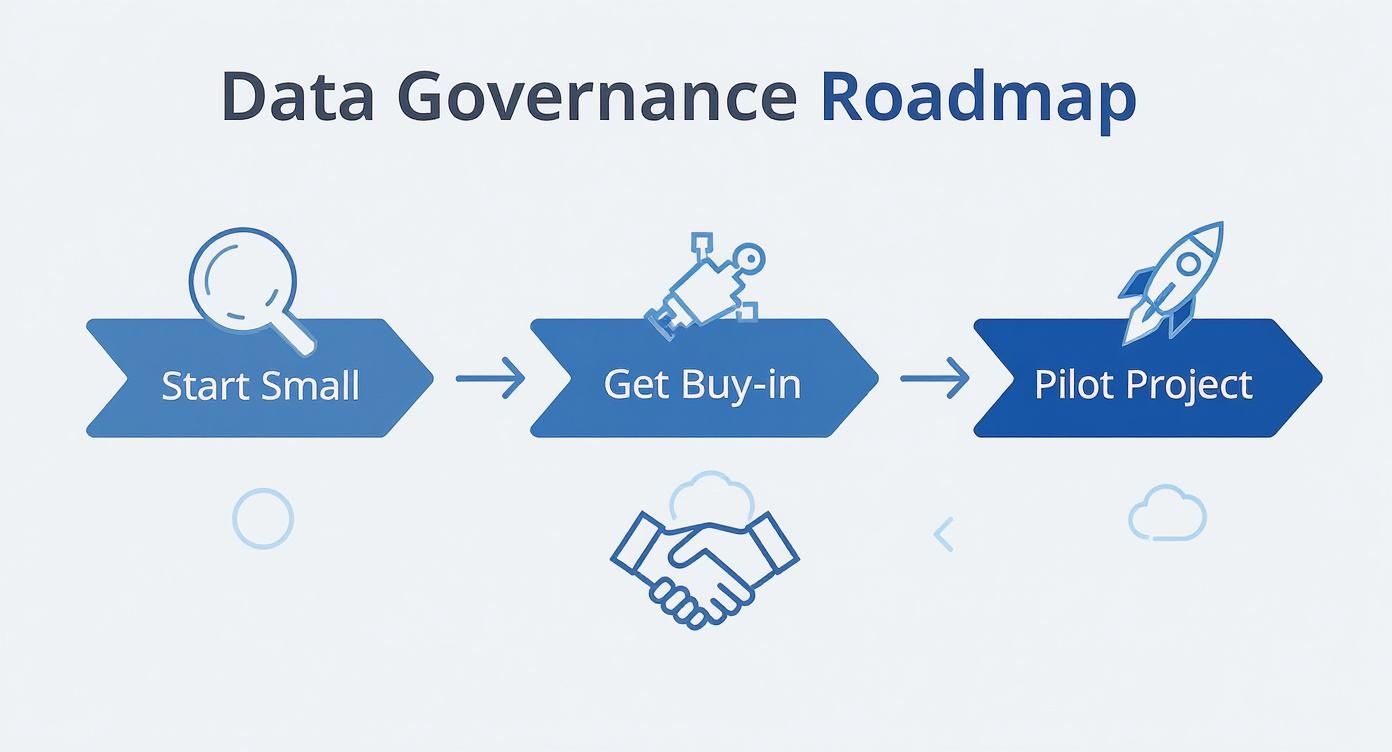
The key is not a massive overhaul from day one. Start small with a focused pilot project. Get a quick win, demonstrate value, and use that success to gain leadership buy-in. This pragmatic approach builds momentum more effectively than a top-down mandate.
Embracing a Data-Driven Future
Ultimately, implementing data governance is about building a culture of data ownership. It eliminates ambiguity. It means that when a critical business decision is made, everyone knows it’s based on numbers they can trust.
This isn't just about today's data. As we move into new frontiers like Artificial Intelligence Governance, these principles become even more critical. By getting the structure right now, you turn a chaotic resource into a strategic asset that fuels growth and long-term success.
Need help building a data governance framework that actually works? Contact DataSimplified to discuss how we can turn your business data into powerful, trustworthy insights.
Got Questions About Data Governance? We’ve Got Answers.
When exploring data governance, many practical questions arise. Here are some of the most common ones we hear from business leaders.
How do we get started without a big budget?
Start small and aim for a quick win. You don’t need expensive software to begin. Pick one critical area where better data will make an immediate difference—customer data is often the best starting point.
Assemble a small group of people who already use this data. Your first step could be as simple as creating a data dictionary in a spreadsheet. The initial investment is focused time and planning, not pricey technology. A successful pilot project delivering a clear return is your best argument for a larger budget later.
Is this just another box-ticking exercise for POPIA?
While meeting POPIA requirements is a significant benefit, it’s not the whole story. Data governance is about making your data reliable enough to fuel smarter business decisions, improve efficiency, and build trust in your numbers.
When your governance program is effective, compliance with regulations like POPIA becomes a natural outcome. This shifts your approach from a reactive compliance headache to a proactive strategy that adds business value.
How long until we see results?
You can see tangible results faster than you think with a focused approach. A well-defined pilot project—like cleaning sales data for a new Power BI dashboard—can show measurable benefits in just a few months.
For instance, you might see more accurate sales forecasts or a dramatic drop in bounced marketing emails after just one data clean-up cycle. Building a full company-wide framework is a long-term effort, but early wins are crucial for proving value and building momentum.
What is the single most critical factor for success?
Executive sponsorship is non-negotiable. You can have the best technology and policies, but without active and visible support from leadership, any governance initiative will fail.
Your leaders must champion data as a strategic asset, not just an IT problem. They need to free up resources—even if it's just people's time—and help enforce new data standards across departments. When leadership makes data governance a business priority, the rest of the organisation will follow.
Need help building your next Power BI dashboard or data automation workflow? Contact DataSimplified to discuss how we can turn your business data into powerful insights.
