
Enterprise Development (ED) under South Africa's B-BBEE codes is often seen as a compliance hurdle—an expense required to meet a scorecard target. A different perspective, however, frames it as a strategic investment into your own supply chain and the broader economy. This isn't about ticking boxes; it's about building genuine economic partnerships that strengthen all parties.
This guide provides a practical framework for designing an ED programme that delivers measurable results.
What B-BBEE Enterprise Development Means for SMEs

For many South African SMEs, Enterprise Development is simply a percentage of Net Profit After Tax (NPAT) that must be spent. This compliance-first mindset misses the strategic opportunity. A well-designed bee enterprise development programme is an engine for your own growth. It helps you build a more resilient local supply chain, discover innovative service providers, and contribute to a more stable economic landscape. When executed correctly, ED stops being an expense and becomes a smart investment.
Shifting From Compliance to Impact
The key is to adopt a data-first approach. Instead of just writing cheques, a modern ED programme uses data to identify high-potential partners, set clear, measurable goals, and track the real-world impact of your support.
This data-driven framework allows you to:
- Select the right partners: Move beyond basic compliance checks to vet beneficiaries on their growth potential and alignment with your business needs.
- Track meaningful progress: Monitor key performance indicators (KPIs) like a beneficiary's revenue growth, job creation, or operational efficiency improvements.
- Prove the value of your investment: Use dashboards to demonstrate the return on your ED contributions to your board, not just for the scorecard but for the wider economy.
By applying the core principles of digitalization in business, you can turn B-BBEE compliance into a competitive advantage. This approach ensures your efforts are not just compliant but commercially savvy, creating sustainable success for your business and the partners you support.
Designing a Smart and Compliant ED Programme
A successful B-BBEE Enterprise Development programme requires a clear plan. It should be a strategic initiative that is commercially smart for both your business and the beneficiary. The goal is to spark genuine, lasting growth for a partner while creating value for your own company.
Your starting point is the B-BBEE Codes of Good Practice. These rules define what qualifies as a legitimate ED contribution and how it is measured. Support can range from direct grants and interest-free loans to discounted services or mentorship from your senior team. Each contribution type has a different scorecard impact, so understanding the mechanics is essential.
Weaving ED into Your Business Goals
The most effective ED programmes align with your company's core operational and commercial goals. This creates a natural synergy where helping another business grow strengthens your own. For example, a mid-sized logistics company could support an emerging, Black-owned courier service. Instead of just giving cash, they could provide route optimisation software or mentor the owner on fleet management. This helps the beneficiary thrive while cultivating a reliable new partner for last-mile deliveries. The compliance cost becomes a strategic supply chain investment.
Setting Measurable Objectives
Once your strategy is set, define specific, tangible objectives backed by Key Performance Indicators (KPIs). Vague goals like "help them grow" are impossible to measure.
Strong, data-driven objectives look like this:
- Increase the beneficiary's monthly revenue by 20% within 12 months.
- Help the beneficiary create three new permanent jobs within 18 months.
- Improve their operational efficiency by implementing an inventory management system, aiming to reduce stock errors by 15%.
A data-first approach is critical, especially in sectors with unique challenges. In South Africa's beekeeping industry, for instance, honey production is inconsistent, partly because fewer than 5% of beekeepers own the land they operate on. A well-designed ED programme could set a KPI to help a beneficiary secure a long-term land lease, tackling a major growth barrier. You can learn more about the challenges facing South Africa's beekeeping sector.
Setting clear targets ensures your programme has a distinct purpose and that its impact can be measured and reported to stakeholders.
Finding and Vetting High-Potential ED Partners

Choosing the right beneficiary for your B-BBEE Enterprise Development programme is the most critical decision. Get it right, and your investment's impact multiplies. Get it wrong, and you waste resources and time. A data-informed vetting process is non-negotiable. It’s about moving past a compliance check to a real assessment of a business's potential.
Your goal is to find businesses that not only meet B-BBEE criteria but also have a solid foundation and a clear ambition for growth. Think of your support as a catalyst that unlocks their potential, not a lifeline for a failing business. Structured due diligence minimises risk and ensures your contributions make a real difference.
Moving Beyond the B-BBEE Certificate
A valid B-BBEE certificate is the starting point, not the final word. True vetting requires a detailed look at the operational and financial health of a potential partner. You need to understand their business model, market position, and current processes to identify where your support will be most valuable.
For example, you might find a small, Black-owned manufacturing business with a great product but a weak distribution network. This is an ideal candidate. Your company could provide mentorship on logistics, facilitate access to your supply chain, or fund a simple e-commerce website. This is a targeted intervention that solves a specific, identifiable problem.
A motivated, coachable entrepreneur with a clear vision is often a better bet than a larger, more established business that is stagnating. Your vetting process must weigh the quality of the leadership team as heavily as the balance sheet.
A Practical Vetting Checklist
To structure your evaluation, collect information across several key areas. This helps you compare candidates fairly and build a solid business case for your final choice. A systematic checklist ensures nothing critical is missed.
Enterprise Development Partner Vetting Checklist
| Vetting Area | Key Questions to Ask | Data Points to Collect |
|---|---|---|
| B-BBEE Compliance | Is their B-BBEE certificate valid? What is their level? Are they at least 51% Black-owned? | Copy of a valid SANAS-accredited B-BBEE certificate. CIPC documents confirming ownership. |
| Operational Viability | Do they have a clear product or service solving a real problem? Are their operations consistent? | Product/service descriptions. Customer testimonials. Basic standard operating procedures (SOPs). |
| Financial Health | How are finances managed? Is there a clear separation between business and personal funds? | Basic financial statements (Income Statement, Balance Sheet) for the past 1-2 years. |
| Leadership & Vision | What is the entrepreneur's vision for the next 3-5 years? Are they open to mentorship? | Founder interviews. Business plan or strategy document. References for the leadership team. |
| Growth Potential | What are the biggest hurdles preventing them from scaling? Is their market growing? | Market research. A list of identified growth barriers (e.g., access to market, funding, skills). |
Using a structured checklist ensures your decision is based on a complete picture, not just a gut feeling. In South Africa's beekeeping industry, for example, commercial players represent only 25% of beekeepers but manage a large share of honeybee colonies. A data-driven ED programme could identify a high-potential small-scale beekeeper and help them scale with better equipment and market access, creating tangible economic change. You can read more about the structure of South Africa's honey trade.
This diligent, data-first selection process ensures your bee enterprise development efforts are directed towards businesses ready for growth.
Structuring Support That Delivers Real Value
Effective Enterprise Development is rarely about just writing a cheque. While financial support is important, the programmes that create lasting change combine funding with practical, hands-on support. Approach it as a partnership, not a donation. You are a mentor, a resource, and a connector. This means understanding what your partner business truly needs to overcome its growth challenges and build a sustainable operation.
Financial Models: Grants vs. Loans
When it comes to financial contributions, the two main options are grants and loans. The best choice depends on the specific situation.
- Grants: A direct cash injection with no repayment obligation. Grants are ideal for funding a critical asset, like new machinery, or covering initial setup costs. The key is to ensure it does not create dependency.
- Loans: Often structured with favourable or zero-interest terms. A loan helps build financial discipline and is an excellent tool for funding an expansion where the return on investment can be clearly projected.
Beyond these, educating a beneficiary on other financial tools can be invaluable. For instance, teaching a small business how invoice factoring works in South Africa can solve critical cash flow gaps while they wait for large clients to pay.
The Value of Non-Financial Support
Often, the most powerful support you can offer is non-financial. Your company possesses a wealth of skills, resources, and networks that can accelerate a smaller business's growth. This is about skills transfer and opening doors. Instead of giving cash for accounting software, provide a spare licence for the system your team uses and have your finance department conduct a training session. This builds lasting capability.
A well-designed non-financial support package addresses a beneficiary's biggest growth obstacles directly. It creates a symbiotic relationship where your expertise gives them the leverage needed to scale successfully.
Practical non-financial support includes:
- Mentorship: Connecting them with senior leaders for regular guidance.
- Skills Training: Offering seats in your internal training programmes.
- Shared Resources: Providing access to spare office space, software licences, or IT infrastructure.
- Network Access: Making introductions to your suppliers, customers, or professional service providers.
This strategic support is vital. For example, government-backed bee enterprise development schemes for beekeeping have helped grow the number of bee farmers from 12 to around 500. These programmes succeed because they combine funding with a collaborative, ecosystem-building approach.
Measuring Real Impact with Business Intelligence
How do you know if your Enterprise Development programme is working? Tracking your spend confirms compliance, but it says nothing about the actual impact. The answer lies in collecting and analysing the right data. A robust measurement system allows you to move beyond basic reporting to see the real-world outcomes of your support. This is the shift from fulfilling a B-BBEE obligation to strategically managing an investment.
Defining KPIs That Matter
First, define Key Performance Indicators (KPIs) that track both compliance and genuine business impact. Compliance metrics are for your B-BBEE verification; impact metrics tell the story of your beneficiary’s growth.
A balanced view includes:
- Compliance KPIs: Tracking total monetary and non-monetary contributions against your Net Profit After Tax (NPAT) target.
- Financial Impact KPIs: Measuring improvements in Gross Profit Margin, Net Profit, and cash flow to prove the business is becoming more financially healthy.
- Operational Impact KPIs: Looking for efficiency gains, such as reduced production errors or faster customer delivery times.
- Social Impact KPIs: Tracking the number of new, permanent jobs created or an increase in the beneficiary's procurement spend with other Black-owned businesses.
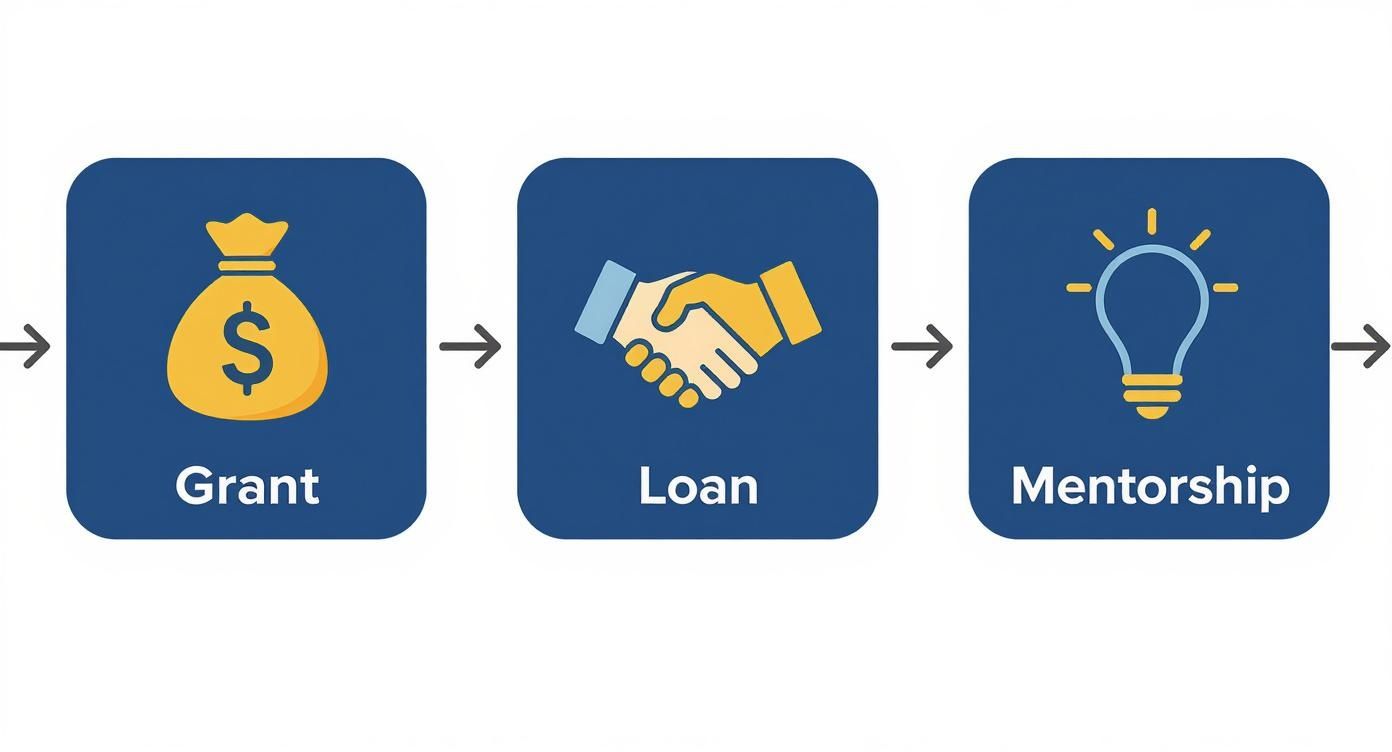
Mapping your support—whether a grant, loan, or mentorship—helps connect specific contributions to the business outcomes you aim to measure.
Sample KPIs for an Enterprise Development Programme
| KPI Category | Example KPI | Data Source | Reporting Frequency |
|---|---|---|---|
| Compliance | Total ED Spend vs. 1% NPAT Target | Internal Financial Records | Quarterly / Annually |
| Financial Impact | % Increase in Gross Profit Margin | Beneficiary's Financial Statements | Quarterly |
| Financial Impact | Reduction in Days Sales Outstanding (DSO) | Beneficiary's Accounting System | Monthly |
| Operational Impact | % Reduction in Customer Order Fulfilment Time | Beneficiary's Operations Data | Monthly |
| Social Impact | Number of Net New Jobs Created (Permanent) | Beneficiary's Payroll Records | Quarterly |
| Social Impact | % of Beneficiary's Spend with 51%+ Black-Owned Suppliers | Beneficiary's Procurement Records | Annually |
This table provides a starting point for building a scorecard that proves both compliance and real-world success.
Streamlining Data Collection and Reporting
Data collection must be simple and consistent to be effective. A shared spreadsheet or a simple online form can work initially. For a more serious bee enterprise development programme, Business Intelligence (BI) tools like Power BI are invaluable. Manual data handling in spreadsheets is time-consuming and prone to errors.
We often set up an ETL (Extract, Transform, Load) process for clients. This data automation pipeline pulls information from a beneficiary's systems, cleans it, and loads it into a central dashboard. Your reports are always up-to-date, freeing you to analyse insights instead of chasing down numbers.
A well-designed Power BI dashboard provides a near real-time view of progress against KPIs. It becomes an interactive tool for spotting trends and addressing issues proactively. For more on proving the value of your initiatives, it is useful in understanding outcome measurement. A clear dashboard turns complex data into a simple story to prove the programme’s ROI to your management team. For more on this, see our guide on designing impactful business intelligence reports.
From Box-Ticking to a Competitive Edge
For many businesses, B-BBEE Enterprise Development feels like a compliance task. However, a well-designed programme is a powerful strategic tool. By shifting from a compliance-first mindset to one driven by data and focused on real impact, your business can make a genuine contribution to the South African economy while strengthening its own supply chain.
The key is a structured programme with clear goals, careful partner selection, and consistent measurement. This is how you turn a regulatory burden into an opportunity for shared growth.
Using business intelligence tools to track progress brings transparency to your programme. It enables smart, timely adjustments, ensuring you maximise your investment and can clearly demonstrate the value of your bee enterprise development efforts.
This data-led approach transforms your ED programme from a cost centre into a competitive advantage. You are not just spending money; you are building resilience, fostering innovation, and creating tangible value for your business and your beneficiary partners.
For a deeper look into using data for strategic decisions, explore our analytics and consulting services.
Need help building your next Power BI dashboard or data automation workflow? Contact DataSimplified to discuss how we can turn your business data into powerful insights.
Your Enterprise Development Questions, Answered
Starting with B-BBEE Enterprise Development (ED) raises many questions. Here are answers to common queries from South African businesses aiming to build impactful programmes.
What qualifies as an Enterprise Development contribution?
Contributions can be financial or non-financial, but they must help the beneficiary improve their operational or financial capabilities.
- Financial support includes direct grants, investments, or interest-free loans.
- Non-financial support often delivers the most value. This includes hands-on mentoring, skills training, providing professional services (like accounting or IT support) at no cost, or even giving a small supplier favourable payment terms to improve their cash flow.
The goal is to provide a hand-up, not a handout. Every contribution must be quantifiable and directly linked to helping the beneficiary build a more sustainable business.
How do we find the right ED beneficiary?
Finding the right partner is crucial. A good place to start is your own supply chain. You may already work with an emerging, Black-owned business with high potential that needs support to grow. Alternatively, you can connect with specialised enterprise development agencies or industry bodies that maintain a roster of vetted, high-potential businesses. The DTI and other government entities also support qualifying enterprises. Always conduct thorough due diligence. A valid B-BBEE certificate is only the first step.
Can we use Power BI to track our B-BBEE scorecard?
Absolutely. Power BI is a highly effective tool for monitoring your entire B-BBEE scorecard, including your bee enterprise development efforts. A central dashboard can pull data from various systems—HR for skills development, procurement for supplier spend, and finance for ED contributions. This provides a live, visual snapshot of your progress against targets across all scorecard elements, allowing you to identify gaps and make proactive decisions long before your verification audit. It’s about managing your scorecard in real-time, not just measuring it annually.
Need help building a Power BI dashboard or automating your data workflows? Contact DataSimplified to discuss how we can turn your business data into powerful insights.
