
Digitalization means using digital technology to improve your existing business processes. It’s not about reinventing your company, but converting manual, paper-based tasks into a digital format to boost efficiency, reduce errors, and save time. A classic example is moving from a paper ledger to accounting software—the task is the same, but the digital method is faster and more accurate.
What Digitalization Actually Means for Your Business
For many small and mid-sized businesses (SMMEs) in South Africa, "digitalization" can sound like a vague buzzword. In reality, it's a practical strategy any business can adopt. It’s not about tearing down your company; it's about making smart upgrades where they count most. Think of it as swapping hand tools for power tools—you're using specific technology to do the same job faster and with more precision.

A Foundation for Growth
Digitalization is the first step toward a full digital transformation. While the terms are often confused, they are different. Digitalization improves what you already do. Transformation uses digital technology to create new ways of doing business. You can't transform what you haven't digitalized.
This is happening now. A recent report showed that 55% of African businesses, including many in South Africa, have started integrating digital tech. The result? An average 30% increase in operational efficiency. The benefits are clear and measurable, as detailed in the research on African digital adoption.
Practical First Steps for SMMEs
Getting started doesn't require a massive budget. It’s about solving real problems with simple solutions.
- Automate Repetitive Tasks: Free up your team from manual data entry, invoicing, or follow-up emails so they can focus on growth.
- Centralise Information: Move from disconnected spreadsheets to a shared database or CRM to ensure everyone works with up-to-date information.
- Improve Data Access: Use tools like Power BI to display sales figures or stock levels on a simple dashboard, enabling faster, better decisions.
When you focus on tangible improvements, digitalization becomes a powerful tool for growth. It’s about building a stronger foundation for your business, one step at a time.
This foundation is why data engineering and business intelligence are so important. They are the logical next steps for any SMME that wants to compete in today's market.
Need a hand figuring out where to begin your digitalization journey? Contact DataSimplified, and we can help you map out practical data solutions that deliver real results.
The Core Technologies Driving Modern Business
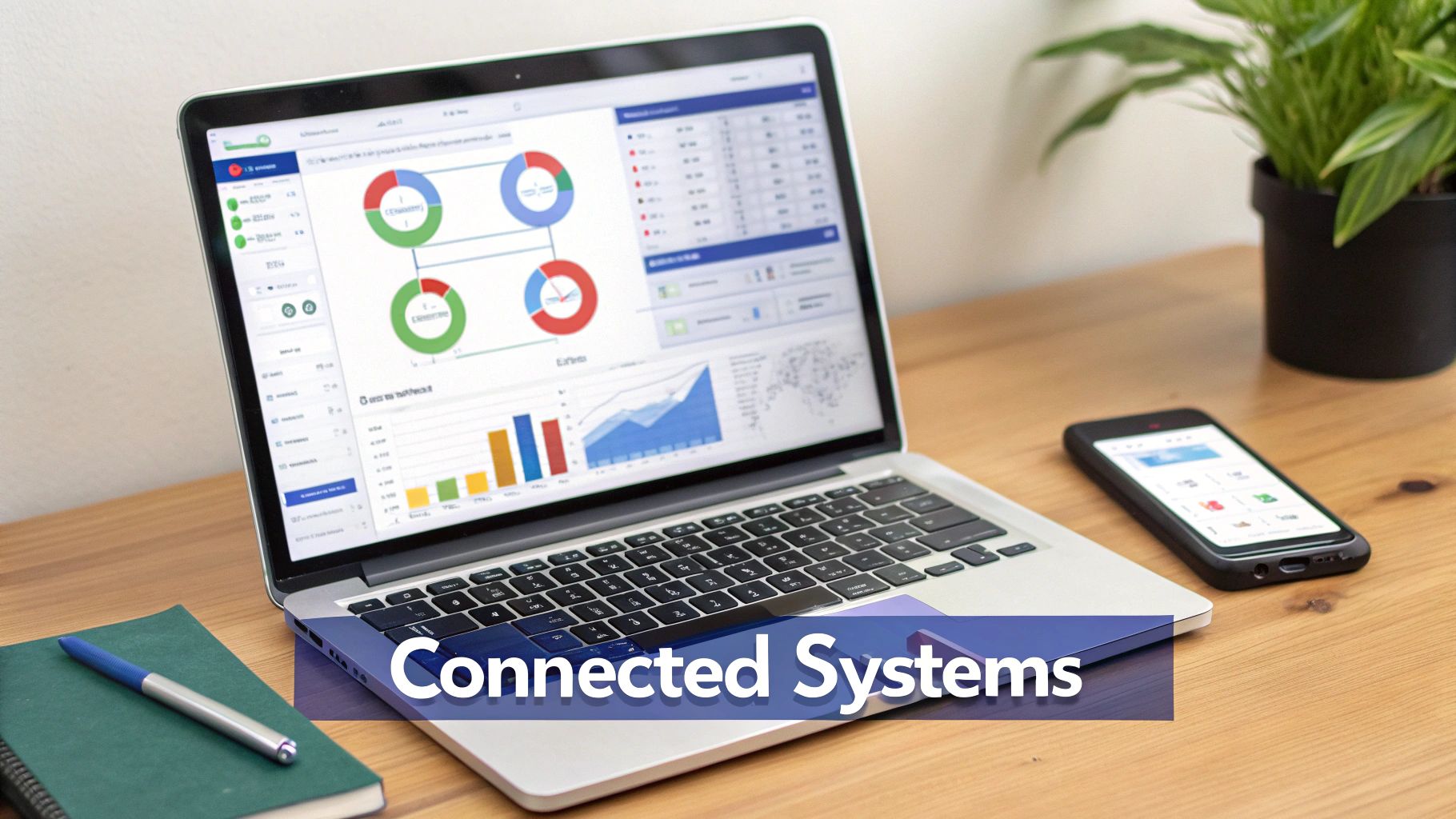
Digitalizing a business involves a system of powerful, interconnected tools. For a non-technical business leader, understanding these core pillars helps you see the big picture. Each piece solves a specific problem, and together they create an efficient machine that drives smarter decisions. These are accessible tools that South African SMMEs are using now to solve everyday challenges.
SaaS Platforms: The Building Blocks
The foundation of most modern operations is Software-as-a-Service (SaaS). These are cloud-based tools you subscribe to, like Xero for accounting or a CRM for sales. Instead of buying and maintaining expensive software, you pay a monthly fee. This gives SMMEs access to top-tier tools without the high cost. The only catch is that your data often ends up trapped in separate systems.
Data Integration: Connecting the Dots with ETL
This is where data integration is critical. The most common method is ETL (Extract, Transform, Load). Think of it as a digital courier that automatically collects data from different apps, cleans it up, and delivers it to one central location.
- Extract: It pulls sales data from your website and financial data from Xero.
- Transform: It standardises formats and removes duplicates to ensure consistency.
- Load: It delivers this clean data into a single destination.
Without ETL, your team is stuck manually combining spreadsheets—a slow, error-prone process. Data automation is the engine that powers a digital business.
A Central Data Warehouse: Your Single Source of Truth
The destination for this clean data is usually a data warehouse. This is a centralised repository built for reporting and analysis. It becomes the "single source of truth" for your organisation. When all departments pull numbers from the same verified source, arguments over whose figures are correct disappear.
A data warehouse turns isolated data points into a cohesive, company-wide asset. It’s the difference between having scattered puzzle pieces and seeing the complete picture.
Business Intelligence: Seeing What Is Really Happening
Once your data is connected and centralised, you can make sense of it with Business Intelligence (BI) tools. Microsoft Power BI is a powerful choice for SMMEs. BI tools connect to your data warehouse and transform raw numbers into interactive, visual dashboards. You get a real-time view of business performance, allowing you to analyse sales trends, customer behaviour, and operational KPIs. For a deeper dive, check out our guide to business intelligence and reporting.
For example, a local logistics company can use ETL to pull data from their website and vehicle GPS. This is loaded into a data warehouse, and a Power BI dashboard visualises it. The operations manager can see which delivery routes are most efficient and adjust them immediately, directly improving the bottom line.
Need help building your first Power BI dashboard or automating your data workflows? Contact DataSimplified to discuss how we can turn your business data into powerful insights.
How Going Digital Delivers Real-World Results
Moving to digital is an investment that delivers clear returns. For South African SMMEs, the benefits are tangible outcomes that boost your bottom line, primarily in three key areas.
Boost Your Operational Efficiency
The first improvement is in your day-to-day operations. By automating repetitive tasks, you free up your team to focus on high-value work instead of admin. Manually capturing invoices and chasing payments can easily consume 10-15 hours a week. Accounting software that automates invoicing can slash that time by over 80%.
Key areas for efficiency gains include:
- Automating Financial Processes: Software for invoicing and payroll reduces manual data entry and human error.
- Streamlining Project Management: Digital tools provide a clear view of tasks, deadlines, and resources, preventing bottlenecks.
- Optimising Inventory Control: Real-time stock tracking helps avoid overstocking or losing sales due to shortages.
Enable Smarter, Data-Backed Decisions
While gut feel has its place, successful businesses make decisions based on solid data. Digitalization gives you the tools to gather and process information from across your company, turning numbers into insights. Instead of guessing which products sell best, a Power BI sales dashboard can show you exactly which items are most profitable and where your sales hotspots are. This clarity allows you to make confident choices about inventory, marketing, and overall strategy.
When your data is organised and accessible, you stop reacting to problems and start proactively finding opportunities.
Enhance Your Customer Experience
In a crowded market, customer experience can be your biggest advantage. Digital tools help you provide smoother, faster, and more personal interactions. A clear example is online payments. The growth of e-commerce in South Africa, projected to exceed R400 billion by 2025, is fuelled by this convenience. Local payment gateways like PayFast and Ozow allow any business to offer secure, easy transactions.
Digitalization helps forge stronger customer connections, as detailed in this guide on digital transformation in customer experience. Using a CRM to track customer interactions allows you to offer more relevant service and anticipate their needs, turning one-time buyers into loyal fans.
Your Practical Roadmap to Getting Started
Taking the first step into digitalization doesn't have to be overwhelming. For most SMMEs, the key is to start small, prove the value, and build momentum. This is a practical, step-by-step guide for leaders who need results without complexity. A clear digital transformation roadmap is essential to structure your efforts. The best approach is to solve one real problem at a time.
Step 1: Pinpoint Your Biggest Bottleneck
First, look at your daily operations. Where do things slow down? What repetitive tasks are wasting your team’s time? Your goal is to find the single biggest point of friction. This is your ideal starting point because solving a problem everyone already feels will deliver an immediate, noticeable impact and get people on board.
Common bottlenecks for SMMEs include:
- Manual invoicing and payment chasing: A major time-drain that consumes hours of admin time weekly.
- Poor stock management: Leading to lost sales from out-of-stock items or cash tied up in slow-moving inventory.
- Disconnected sales and marketing data: It's hard to see which marketing efforts are actually driving revenue.
- Painful report generation: A slow, error-prone monthly process of pulling data from multiple spreadsheets.
Step 2: Launch a Small Pilot Project
Once you’ve identified your bottleneck, launch a small, focused pilot project. This is often called a Minimum Viable Product (MVP). It’s about solving one specific issue to prove the concept. This approach keeps risks and costs low while demonstrating value quickly. A perfect example is creating a simple Power BI sales dashboard. If your pain point is a lack of daily sales figures, a dashboard that automatically pulls data from your accounting software provides instant clarity.
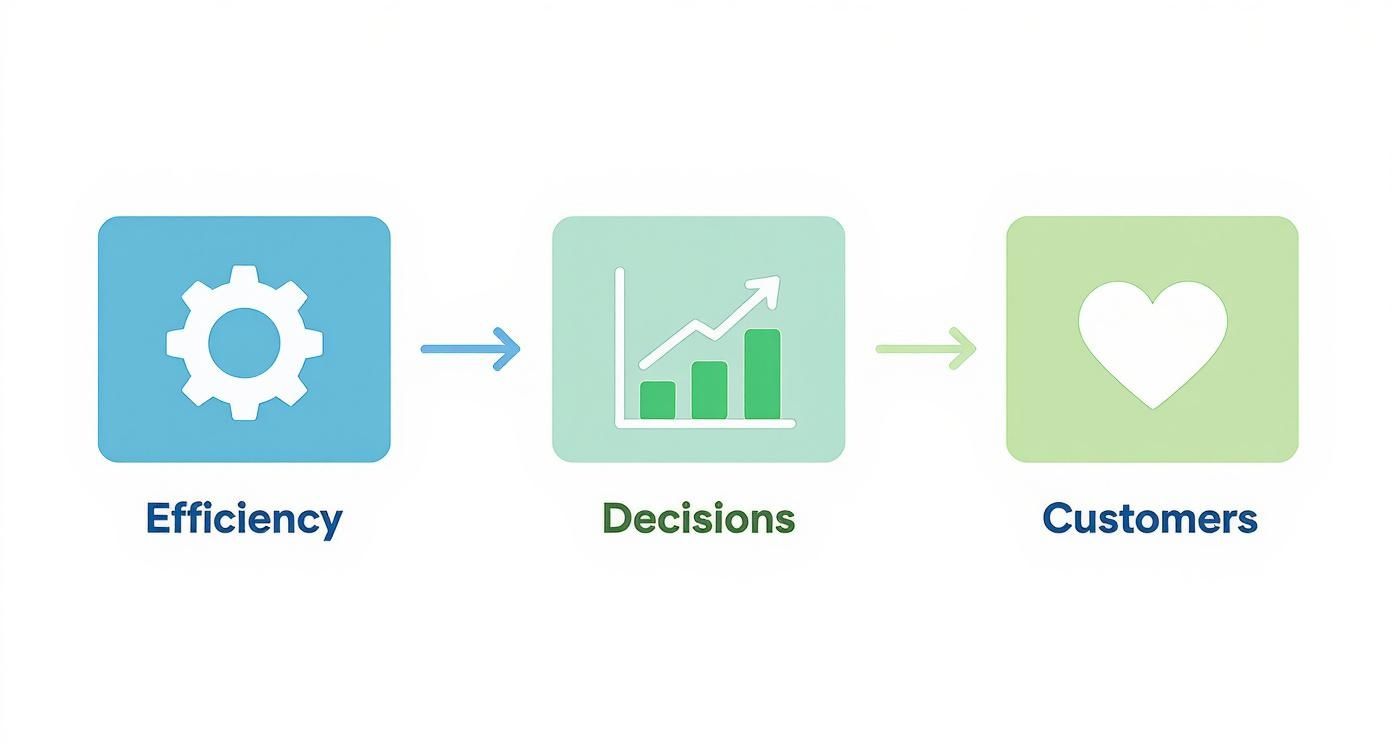
This simple flow—efficiency gains leading to smarter decisions and a better customer experience—creates a powerful ripple effect.
Step 3: Build Your Initial Data Pipeline
To power your dashboard, you need a reliable way to get data to the right place. This is where you build your first data pipeline, typically with ETL (Extract, Transform, Load) tools. ETL acts as automated plumbing for your data. It extracts information from a source (like Xero), transforms it into a clean format, and loads it into a central spot for analysis. Getting this right is the foundation for everything else. For more details, see our data simplification guide for SMBS.
Step 4: Insist on Good Data Quality
The insights you get are only as good as the data you put in. This is the "garbage in, garbage out" rule.
From day one, establish simple rules for keeping your data clean, accurate, and consistent. This could be as basic as standardising how you enter customer names or ensuring every sale is logged with the correct product code.
Fixing data quality issues early saves you from major headaches later. It’s much easier to build good habits now than to untangle a messy database in the future.
Step 5: Grow From Your Wins
Once your pilot project is a success, you have proof that this works, a clear return on investment, and buy-in from your team. Use this momentum to justify the next project. Did the sales dashboard help you identify a new market? The next project could be a targeted marketing automation campaign. By taking it one step at a time, you create a cycle of continuous improvement that sustainably modernises your business.
Digitalization Implementation Roadmap for SMMEs
This table summarises the key phases of your journey.
| Phase | Key Actions | Primary Outcome | Example Technologies |
|---|---|---|---|
| 1. Assessment & Strategy | Identify a key business bottleneck. Define clear success metrics for a pilot project. | A focused problem statement and a measurable goal. | N/A (Business Process Analysis) |
| 2. Pilot Project (MVP) | Develop a small-scale solution (e.g., a dashboard) to address the bottleneck. | A working prototype that proves value and secures team buy-in. | Power BI, Google Data Studio, Zoho Analytics |
| 3. Foundational Data Pipeline | Set up ETL processes to automate data extraction and loading into a central location. | A reliable, automated flow of clean data ready for analysis. | Fivetran, Stitch, Airbyte, Azure Data Factory |
| 4. Data Governance | Establish rules for data entry and quality. Assign ownership for data accuracy. | Consistent, trustworthy data that supports reliable decision-making. | Excel (for rules), internal process docs |
| 5. Scale & Iterate | Use the success of the pilot to tackle the next bottleneck. Expand data sources. | A cycle of continuous improvement and growing business-wide impact. | CRM (HubSpot), ERP (NetSuite), Marketing Automation (Mailchimp) |
This roadmap provides a clear path from identifying your first problem to building a data-driven culture.
Need help building your next Power BI dashboard or data automation workflow? Contact DataSimplified to discuss how we can turn your business data into powerful insights.
Common Pitfalls and How to Sidestep Them
A digitalization journey is exciting, but the path is rarely straight. Knowing the common mistakes from the start helps you navigate around them, ensuring your investment leads to growth, not frustration.
Mistake 1: Technology First, Problem Second
This is the biggest pitfall. It's easy to be impressed by flashy software before you’ve clearly defined the business problem you need to solve. A powerful tool is useless if it doesn’t fix a real operational bottleneck. This "solution-in-search-of-a-problem" approach almost always ends in wasted money. The fix is simple: start with the pain point, not the platform. Define the exact process that’s costing you time or money before you look at technology.
Mistake 2: Ignoring Poor Data Quality
Digitalization runs on data. If the data you feed into new systems is messy or incomplete, the results will be unreliable. This is the classic "garbage in, garbage out" principle. To avoid this, make data quality a priority from day one.
- Establish Clear Standards: Create simple, documented rules for how data is entered.
- Assign Ownership: Make someone accountable for the accuracy of key data sets.
- Clean as You Go: Implement regular processes to review and clean your data.
A business intelligence tool like Power BI is only as smart as the data it’s connected to. Data governance is a fundamental business discipline.
Mistake 3: Failing to Secure Team Buy-In
If your team doesn’t use a new system, the project is a failure. Resistance often comes from feeling excluded from the decision or fearing technology will replace jobs. Forcing a new tool on your staff is a recipe for resentment. The solution is to involve your team from the beginning. The people performing manual tasks have valuable insights. Ask for their input on problems and solutions. When employees feel part of the decision, they become champions for change.
Mistake 4: Trying to Boil the Ocean
It’s tempting to try to fix everything at once. But this "big bang" approach is overwhelming, expensive, and risky for an SMME. Trying to digitalize every department simultaneously spreads your focus too thin. Instead, start small with a focused pilot project. Pick one high-impact bottleneck and solve it with an MVP. A successful pilot provides a quick win, proves value, and teaches lessons you can apply to the next phase.
Need help navigating these challenges and building a solid digitalization strategy?
Contact DataSimplified to discuss how we can turn your business data into powerful insights.
Measuring Success and Building a Data-Driven Culture
How do you know if your investment in technology is paying off? Without clear metrics, digitalization can feel like an expensive guess. Link your projects directly to tangible business outcomes to ensure every rand spent delivers a return. Focus on Key Performance Indicators (KPIs) that tell a real story. For a South African SMME, effective KPIs are practical, easy to track, and show genuine operational changes.
Setting Practical KPIs for Digitalization
Zero in on metrics that reflect real business improvements. Tracking the right numbers builds a case for future investment and motivates your team.
Here are a few powerful examples for an SMME:
- Reduction in Manual Reporting Hours: How much time does your team save each month now that reports are automated with a tool like Power BI?
- Increase in Online Sales Conversion Rate: What percentage of visitors are now completing a purchase on your revamped e-commerce platform?
- Decrease in Order Fulfilment Time: How much faster are orders dispatched since digitalizing your inventory and logistics?
- Improved Customer Support Resolution Time: Are customer queries being solved faster with your new CRM or support system?
These metrics provide undeniable proof that your efforts are working. Our team provides expert analytics and consulting services to help businesses define and track the KPIs that truly matter.
Fostering a Truly Data-Driven Culture
Technology alone is not enough. Real value is unlocked when your entire team embraces a data-driven mindset. This is a cultural shift from decisions based on gut feel to choices guided by data insights. A data-driven culture empowers employees at all levels to ask questions and find answers in the company's data. It’s about making dashboards and reports accessible to everyone, not just managers.
The goal is to make data a common language across your organisation. When your sales team, operations staff, and leadership are all looking at the same trusted information from a Power BI dashboard, collaboration improves and everyone pulls in the same direction.
This cultural change requires commitment from leaders who champion the value of data and invest in training. South Africa’s national strategy is promoting this, with government funding allocated to digital skills initiatives. Training your team to use data is what turns a technology project into a lasting competitive advantage.
Need help building the dashboards and culture to drive your business forward? Contact DataSimplified to discuss how we can turn your data into your most powerful asset.
Answering Your Digitalisation Questions
Let's address some common questions business leaders in South Africa ask when considering digitalization.
How Much Does It Cost to Start Digitalising My Business?
The cost can vary, but you don’t need a massive budget to begin. The key is to start small and smart. Instead of a company-wide overhaul, focus on a high-impact pilot project. Setting up a Power BI dashboard to track daily sales is a focused project that delivers immediate value at a fraction of the cost of a full-scale implementation. Modern subscription-based tools (SaaS) also make costs more manageable with monthly fees instead of large upfront expenses.
Do I Need to Hire a Full-Time Technical Team?
Not necessarily. For most SMMEs, it's not the best approach. While modern tools are designed to be user-friendly, getting the foundations right is a specialist job. Setting up initial data pipelines (ETL) and building crucial dashboards requires technical skill. For most, the most efficient route is to partner with a data consultant. We handle the heavy lifting—building core systems and automating data flows—and then train your team to use the tools.
This strategy gives you access to enterprise-level data capabilities without the overhead of a full-time technical team. It’s about empowering your people, not replacing them.
My Business Data Is a Mess. Can I Still Benefit?
Absolutely. In fact, you're the perfect candidate. Messy, disconnected data isn’t a roadblock; it's the reason to start. The first step is data engineering—the process of cleaning, structuring, and centralising that scattered information. This foundational work transforms raw data from a liability into a valuable asset. We help businesses pull information from spreadsheets, accounting software, and CRMs into a single source of truth you can trust. Once that's done, building powerful dashboards and automating reports becomes straightforward.
Ready to answer your business questions with clear, reliable data? DataSimplified can help you build the data pipelines and Power BI dashboards you need to get started.
Contact us today to book a no-obligation consultation.
