
B-BBEE Enterprise Development is more than a compliance requirement; it’s a strategic investment in South Africa’s economic ecosystem. For small and mid-sized businesses, a well-executed programme builds a stronger local supply chain and creates genuine competitive advantages.
What is Enterprise Development?
Enterprise Development (ED) is a core component of the Broad-Based Black Economic Empowerment (B-BBEE) codes. It requires established companies to support the growth of small, Black-owned businesses through financial and non-financial contributions.
The goal is to help Exempted Micro Enterprises (EMEs) and Qualifying Small Enterprises (QSEs) become sustainable and commercially successful. This support can range from direct funding and mentorship to providing access to your company’s infrastructure and skills. A successful ED programme doesn’t just earn B-BBEE points; it develops a more resilient economic environment.
ED vs. Supplier Development: A Key Distinction
Enterprise Development is often confused with Supplier Development (SD), but they target different groups.
- Supplier Development (SD) focuses on improving the capabilities of Black-owned businesses already in your supply chain. You invest in them to enhance their quality, capacity, or efficiency, making them better partners for your business.
- Enterprise Development (ED) supports Black-owned businesses that are not currently your suppliers. This creates a pipeline of potential future partners and drives broader economic growth.
Think of it this way: SD is like upskilling your existing team, while ED is like scouting and developing new talent for the future. Both are crucial and contribute to the same element on your B-BBEE scorecard.
Why Enterprise Development Matters for Your Business
Beyond the scorecard, a strategic ED programme offers tangible business benefits. It helps you build a more diverse and resilient local supply chain, reducing your reliance on a small number of suppliers and mitigating risk.
By empowering SMMEs to thrive in the digital age, you also fuel innovation and job creation. This turns a compliance task into a genuine competitive advantage. A strong ED strategy creates a powerful ripple effect: as your beneficiary grows, they hire more people and contribute to a more stable business environment for everyone.
How Enterprise Development Scoring Works
The B-BBEE scorecard can seem complex, but the logic for Enterprise and Supplier Development (ESD) is straightforward. Scoring is based on contributing a set percentage of your company’s Net Profit After Tax (NPAT) to qualifying initiatives. This ensures that the support you provide is proportional to your own success.
Key Targets and Calculations
To earn the maximum points under the ESD element, your business must meet two primary spending targets:
- Enterprise Development: Contribute 1% of your NPAT to qualifying Black-owned businesses that are not current suppliers.
- Supplier Development: Contribute 2% of your NPAT to qualifying Black-owned businesses that are already your suppliers.
A “qualifying contribution” includes monetary or non-monetary support that helps the beneficiary business become more sustainable.
This infographic provides a clear overview of how these initiatives create broader economic benefits.
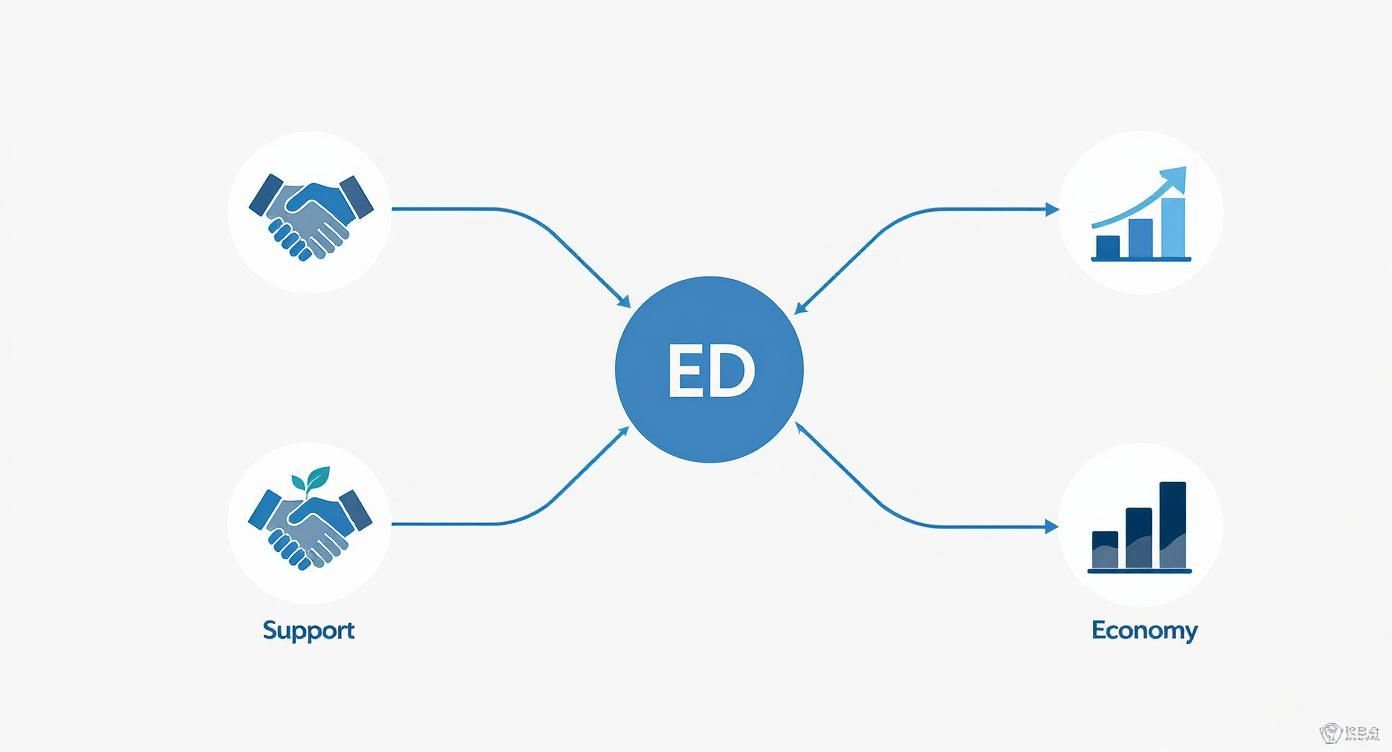
Effective ED combines different types of strategic support to foster genuine growth and strengthen the wider economy.
Who Qualifies for Support?
Contributions must go to beneficiaries that are at least 51% Black-owned and fall into one of two categories:
- Exempted Micro Enterprises (EMEs): Businesses with an annual turnover below R10 million.
- Qualifying Small Enterprises (QSEs): Businesses with an annual turnover between R10 million and R50 million.
This focus ensures support is directed to smaller, emerging businesses where it can have the greatest impact.
A common pitfall is assuming any support qualifies. To earn points, contributions must be structured and measurable, with a formal, written agreement outlining the development plan for the beneficiary.
Beyond the Basic Scorecard
The B-BBEE framework also includes other critical elements like skills development, procurement spend, and access to finance. For example, the Financial Sector Code introduces a unique “Access to Financial Services” element to address the capital constraints that often hinder emerging enterprises. You can learn more by reviewing official B-BBEE sector updates.
Ultimately, scoring well in bbbee enterprise development requires a clear understanding of these targets and rules. Strategic contributions not only meet compliance goals but also make a real, lasting difference.
Need help building a Power BI dashboard to track your ED contributions or automating your compliance reporting? Contact DataSimplified to discuss how we can turn your business data into powerful insights.
Making Contributions That Count

For B-BBEE Enterprise Development (ED), the most effective programmes go beyond just writing a cheque. The B-BBEE codes encourage a smarter approach: using your company’s unique skills and resources to help another business solve real-world problems. The aim is to provide hand-ups, not handouts.
This transforms the relationship from a simple transaction into a genuine partnership. The programmes that deliver the best results are those where the sponsor invests time and expertise to solve the beneficiary’s most critical challenges.
Beyond Financial Handouts
Non-monetary support is often where the most value is created. It gives a smaller business access to assets and expertise they could not afford on their own.
Here are a few powerful non-monetary contributions:
- Mentorship and Coaching: Your experienced financial director guiding a new entrepreneur on cash flow management offers invaluable strategic input.
- Access to Infrastructure: Offering a small business free use of spare office space or your high-speed internet can be a game-changer.
- Skills Transfer: Your marketing team could run a workshop on digital marketing for your beneficiary’s staff, transferring high-value, practical skills.
- Professional Services: Providing pro-bono legal or accounting support helps them build a solid operational foundation.
These contributions are fully recognised for your B-BBEE scorecard, provided their value is correctly documented and quantified.
Smarter Financial Support
Even direct financial help can be structured for greater impact. A one-off grant provides temporary relief but may not solve underlying issues. The goal should be to build long-term financial resilience.
The most powerful Enterprise Development initiatives create lasting impact. A loan guarantee, for instance, can unlock far more capital for a growing business than a simple cash grant of the same value.
Consider these strategic financial options:
- Interest-Free Loans: Provide capital for equipment or expansion without the burden of commercial interest rates.
- Favourable Payment Terms: If you are a customer, paying their invoices ahead of schedule is a simple way to improve their cash flow.
- Loan Guarantees: Use your company’s financial standing to back a loan, helping them secure larger funding from a bank.
- Discounts on Services or Goods: Offer your products or services at a steep discount to give them access to essential tools while reducing their costs.
Monetary vs. Non-Monetary ED Contributions
Comparing different approaches highlights the importance of long-term impact over immediate cash value.
| Contribution Type | Example | Potential Impact on Beneficiary |
|---|---|---|
| Monetary (Direct) | Giving a direct grant of R100,000 for operational expenses. | Provides immediate cash flow relief but may not build long-term capacity. |
| Monetary (Indirect) | Guaranteeing a R500,000 bank loan for new machinery. | Unlocks significant capital for growth and acquiring critical assets. |
| Non-Monetary | Providing free access to your company’s CRM software and training. | Improves their sales processes without adding a recurring operational cost. |
| Human Capital | Your CFO mentors their founder on financial modelling and forecasting. | Transfers invaluable expertise, improving their strategic planning for years. |
The most effective programmes blend smart financial aid with hands-on, non-monetary support. This approach ensures you are not just ticking a box for your B-BBEE Enterprise Development—you are helping to build a sustainable, successful business.
Need help building your next Power BI dashboard or data automation workflow? Contact DataSimplified to discuss how we can turn your business data into powerful insights.
Designing an ED Programme for Real Impact
A successful B-BBEE Enterprise Development (ED) programme is a structured, strategic partnership that delivers genuine growth. The goal is to move from a compliance task to a well-managed project built on clear goals and mutual trust.
It starts with finding the right beneficiary. This means identifying a 51% Black-owned EME or QSE where your specific skills and resources can make a real difference. A scattergun approach rarely works; look for strategic alignment. Does the business operate in a sector you understand? Can your team’s expertise help solve their biggest problems?
The Importance of Due Diligence
Once you identify a potential beneficiary, proper due diligence is essential. This step protects your investment, ensures compliance, and prevents future complications. Rushing this process often leads to wasted resources and lost B-BBEE points.
Your due diligence checklist should include:
- B-BBEE Status: Obtain a valid B-BBEE affidavit or certificate to confirm their ownership and compliance level.
- Operational Health: Assess their financial stability and operational capacity. You want to support a business with real growth potential.
- Needs Analysis: This is the most critical part. Spend time understanding their operations, challenges, and goals. Your support must be tailored to what they actually need, whether it’s market access, technical skills, or improved cash flow.
Formalising the Partnership Agreement
A verbal promise will not pass a B-BBEE verification audit. A formal, written Enterprise Development Agreement is non-negotiable. This document serves as the roadmap for your partnership and the cornerstone of your audit trail.
Think of the ED Agreement as the blueprint for your project. It eliminates guesswork, sets clear expectations for both sides, and provides a solid framework for measuring success. Without it, you are flying blind.
The agreement must define the scope of support, detail specific objectives, state the exact value of your contribution, and outline the desired outcomes. This formalises the relationship and creates a solid foundation for tracking progress.
Building a Measurable Development Plan
The heart of the agreement is the Development Plan—a concrete action plan co-created with the beneficiary.
A robust Development Plan must include:
- Clear Objectives: Define specific, measurable goals. For example, “Increase revenue by 15% within 12 months” or “Implement a new financial management system by Q3.”
- Defined Activities: List the exact support you will provide, such as monthly mentorship sessions, access to specialised software, or an interest-free loan.
- Timelines and Milestones: Set clear deadlines for each activity to maintain momentum and ensure accountability.
- Key Performance Indicators (KPIs): Define the metrics for success, such as jobs created, revenue growth, or improved operational efficiency.
This structured approach is vital. South Africa’s SMEs are the engine of our economy, yet as highlighted in analysis on the economic role of SMEs on Daily Maverick, they often struggle with market access and operational hurdles. Targeted, measurable support is essential for their growth.
Setting clear KPIs allows you to use business intelligence tools, like a Power BI dashboard, to monitor progress. This data-driven approach gives both you and the beneficiary clear insights, turning your ED programme into a strategic investment.
Need help building your next Power BI dashboard or data automation workflow? Contact DataSimplified to discuss how we can turn your business data into powerful insights.
Automating Your ED Tracking and Reporting
Managing the administration for a B-BBEE Enterprise Development programme can be a significant drain on resources. Juggling invoices, logging mentorship hours, and documenting every contribution is time-consuming and prone to human error.
Smart data management can solve this. Instead of scrambling for documents before a verification audit, you can build an automated system that handles the heavy lifting, shifting your process from reactive to proactive.
Building an Automated Data Pipeline
The first step is to centralise your information using an ETL (Extract, Transform, Load) pipeline. An ETL process acts as an automated conveyor belt for all your ED-related data.
- Extract: The system automatically pulls data from various sources—accounting software, project management tools, and timesheets.
- Transform: It cleans and standardises this information, ensuring consistency in formats and naming conventions.
- Load: It loads the clean data into a central data warehouse, creating a single source of truth for your entire ED programme.
This eliminates tedious manual data entry, saves time, and significantly reduces the risk of errors, ensuring your records are always current and audit-ready.
Visualising Progress with Power BI Dashboards
Once your data is organised, a custom-built Power BI dashboard can turn complex datasets into clear, visual reports. This gives you a live snapshot of your programme at a glance.
Your dashboard can track spending against your 1% NPAT target, monitor beneficiary KPIs, and highlight progress in real-time.
A well-designed dashboard doesn’t just report on past performance; it helps you make better future decisions. By seeing which initiatives deliver the best results, you can optimise your strategy and maximise your impact.
Understanding the fundamentals of business intelligence and reporting is the first step toward building these powerful tools.
From Manual Chaos to Automated Clarity
The transition from spreadsheets to an automated system is transformative. It moves you from a slow, risky process to a fast, reliable, and controlled one. A practical guide on how to automate business processes offers valuable insights that apply directly to ED tracking and reporting.
Here is a comparison of the two approaches:
Manual vs. Automated ED Tracking
| Process | Manual Approach (Spreadsheets) | Automated Approach (Data Pipelines & Dashboards) |
|---|---|---|
| Data Collection | Manual entry from invoices, emails, and logs. Slow and prone to errors or omissions. | Data is pulled automatically from multiple sources, ensuring accuracy and completeness. |
| Spend Tracking | Calculations against NPAT are manual and often outdated. | A real-time dashboard provides an instant view of your spend against targets. |
| Beneficiary Monitoring | Progress is only visible through periodic reports, making it hard to get a current view. | Live KPI tracking allows for timely intervention and support when needed. |
| Audit Preparation | A last-minute scramble to find and organise documents. Stressful and risky. | Generate a complete, audit-ready report with a single click. |
By using data automation, you can transform B-BBEE Enterprise Development from a compliance burden into a streamlined, data-driven function. It saves time and provides the robust evidence needed to secure your points and prove your impact.
Need help building your next Power BI dashboard or data automation workflow? Contact DataSimplified to discuss how we can turn your business data into powerful insights.
Avoiding Common Enterprise Development Pitfalls
Many well-intentioned Enterprise Development (ED) programmes fail due to a few avoidable mistakes. Getting it wrong wastes a valuable opportunity and puts your B-BBEE points at risk. Knowing these common pitfalls helps you build a structured approach that protects your investment and delivers real results.
Pitfall 1: Choosing the Wrong Partner
Selecting an unsuitable beneficiary is the fastest way to derail an ED programme. Rushing this step without proper due diligence can lead to a mismatch where the beneficiary lacks the operational maturity or vision to use your support effectively. A common error is skipping a thorough needs analysis, resulting in you offering help they don’t actually need.
How to avoid this:
- Conduct due diligence: Verify their B-BBEE status, check their financial health, and ensure they are operationally ready for growth.
- Find strategic alignment: The best partnerships occur when the beneficiary’s needs match your company’s core strengths and expertise.
- Perform a needs analysis: Work with the business to pinpoint their primary challenges and growth opportunities before committing.
Pitfall 2: The “Handshake Agreement”
Operating without a formal, written development plan is a major red flag for verification agencies. An informal approach makes it nearly impossible to track progress or prove your contributions. Without clear goals, timelines, and measurable targets, the initiative lacks direction and focus.
The B-BBEE framework is designed to drive measurable growth. A verbal promise or an unstructured donation is insufficient because it provides no evidence of a developmental journey. This is a common reason for points being disqualified during an audit.
Since the Act was first introduced, with codes being refined over time, the focus has remained on productive growth for Black entrepreneurs. You can get more background on these key B-BBEE milestones on Global Business.
Pitfall 3: The Last-Minute Document Scramble
Waiting until an audit is imminent to gather documentation is a recipe for chaos. Trying to find invoices, mentorship logs, or proof of payment from months ago is stressful and often leads to lost evidence. This scramble significantly increases the risk of losing points, as verification agents require a clean, organised paper trail.
How to avoid this:
- Log activities in real-time: Use digital tools to record every contribution and activity as it happens.
- Automate evidence collection: Set up data pipelines to automatically pull invoices, payment confirmations, and reports into a central, secure location.
- Use live dashboards: A dashboard built in a tool like Power BI provides an instant, audit-ready snapshot of all ED activities and documents.
By avoiding these common mistakes with careful planning and smart data management, you can ensure your bbbee enterprise development programme delivers on its promise.
Need a hand building a Power BI dashboard or automating your data workflows? Get in touch with DataSimplified to see how we can turn your business data into a powerful compliance tool.
Turn B-BBEE Data Into a Strategic Asset
For many businesses, B-BBEE Enterprise Development is treated as a compliance task. But a data-driven approach can transform it into a strategic advantage that builds a stronger South African economy. By moving away from spreadsheets and embracing automation, you can turn this requirement into a powerful business tool.
It’s about measuring what matters, staying audit-ready without the last-minute panic, and making smarter decisions about your ED investments.
From Compliance to Competitive Edge
Viewing B-BBEE Enterprise Development through a data lens changes the conversation. You move beyond hitting minimum spend to asking more important questions: Are our contributions helping these businesses grow? Which types of support—mentorship, funding, or market access—deliver the best results?
Modern business intelligence tools provide the answers. With well-designed data pipelines and clear reporting, you can move beyond guesswork. This allows you to build a programme that not only secures your B-BBEE points but also develops a more resilient and diverse supply chain for your own business.
Turning your compliance data into insights creates a powerful feedback loop. This flow of information helps you fine-tune your strategy, maximise your impact, and prove the tangible value your business is adding to the broader economy.
Implementing a Data-Driven Strategy
Getting started means consolidating all your data into a single, reliable source—including contribution records, beneficiary progress reports, and financial tracking. Automating this process reduces human error and frees up your team to focus on building partnerships, not paperwork.
Once your data is centralised, new possibilities emerge:
- Real-time Monitoring: Track your spend against targets on a Power BI dashboard and monitor beneficiary KPIs live, without waiting for month-end reports.
- Predictive Insights: Analyse trends to identify which initiatives are most effective at creating jobs or boosting revenue for your partners.
- Simplified Audits: Generate comprehensive, evidence-backed reports with a single click, ensuring you are always prepared for an audit.
To see how we help businesses build these systems, review our approach to analytics and consulting. We specialise in turning raw data into strategic assets.
Need help building a Power BI dashboard to track your ED contributions or automating your compliance reporting? Contact DataSimplified to discuss how we can turn your business data into powerful insights.
