
A business transformation agency is a hands-on partner that helps modernise your operations. They manage the entire journey from initial strategy to implementing new technology, ensuring your business achieves measurable improvements without just talk.
What Does a Business Transformation Agency Actually Do?
Think of a business transformation agency as a general contractor for your company’s core processes. Instead of you coordinating different specialists, they orchestrate the entire project, from blueprint to final handover, ensuring every part works together.
For small to mid-sized businesses (SMEs) in South Africa, this partnership provides access to specialised skills in data engineering, automation, and business intelligence without the cost of a large in-house team. The focus is always on practical, tangible results that improve how you operate.
This is no longer a "nice-to-have." The African digital transformation market, led by South Africa, is projected to grow from USD 30.24 billion in 2025 to USD 63.31 billion by 2030. This growth highlights how critical it is for SMEs to adapt to remain competitive.
Bridging the Gap Between Ideas and Action
At its core, an agency’s job is to connect your business goals with the right technology. They help you analyse, redesign, and streamline business processes for efficiency, which leads to significant operational improvements.
The key difference is that they don’t just recommend changes; they build the solutions.
An agency’s real value is in its ability to execute. It’s the difference between being handed a map and having an experienced guide lead you through the mountains to the summit.
To understand how a transformation agency drives results for SMEs, let's look at the core pillars they focus on.
Core Transformation Pillars for SMEs
A good agency focuses on specific areas to create the most impact. Here’s a breakdown of what that typically involves.
| Pillar | Objective | Example Action |
|---|---|---|
| Strategy & Planning | Define clear goals and create a roadmap to modernise operations. | Conducting workshops to map current workflows and identify bottlenecks. |
| Technology & Automation | Build or implement the right tools to solve specific business problems. | Developing a custom app to manage inventory or automating the invoicing process. |
| Data & Insights | Turn raw business data into clear, actionable intelligence. | Building a Power BI dashboard that shows real-time sales performance. |
| Change Management | Ensure the team understands and adopts new tools and processes. | Providing hands-on training and ongoing support for new software. |
These pillars provide a practical framework for turning a company's potential into performance.
What This Looks Like in Practice
Instead of just talking about being "data-driven," an agency builds the systems you need to use your data effectively. This usually involves a few key activities:
- Modernising Processes: They find manual, repetitive tasks that drain time and replace them with smart, automated workflows.
- Making Data Useful: They set up tools like Power BI dashboards that transform raw sales numbers into insights your team can use to make better decisions.
- Implementing Technology: This could mean developing a lean custom SaaS application to solve a unique problem or integrating existing software to work together seamlessly.
The goal is to unlock the value hidden in your operations and data, making your business stronger and more resilient. By exploring our data and software development services, you can see how these concepts become real solutions for growing businesses.
The Core Services That Drive Growth
A genuine business transformation agency moves beyond strategy to practical execution. The goal is to connect specific services to tangible outcomes you can measure in your daily operations. For most small and mid-sized businesses, this work stands on four key pillars.
These services create clarity and efficiency, turning operational headaches into a competitive edge.
Strategic Planning: Your Blueprint for Success
Before any development or data analysis begins, you need a solid plan. Strategic planning is a discovery phase where a transformation partner digs in to understand your business. It’s about asking the right questions to uncover the root causes of your challenges, not just the symptoms.
This is a collaborative process to map current processes, pinpoint bottlenecks, and define what success looks like in measurable terms. The result is a clear, actionable roadmap that outlines priorities, timelines, and expected outcomes.
Data Engineering and Automation: The Engine Room
Many businesses sit on a goldmine of data they can't use. Data engineering is the technical work of building the "plumbing" to collect, clean, and organise information from all your systems—accounting software, CRM, inventory management, and more.
Once the data is structured, data automation builds workflows that handle repetitive manual tasks automatically.
- ETL and Integration: Extract, Transform, Load (ETL) is the process of pulling data from different systems into a single, reliable source. It ensures everyone works from the same set of facts.
- Automated Reporting: Automation can generate and distribute reports on a schedule, freeing up your team from hours of spreadsheet work for more strategic tasks.
- Workflow Triggers: For example, an automated system can notify your sales team when a key client places an order, ensuring prompt follow-up without manual intervention.
Business Intelligence with Power BI: Turning Data into Decisions
With clean, organised data, the next step is to make sense of it. This is where business intelligence (BI) comes in, turning raw numbers into visual insights for smarter, faster decisions. It answers critical questions like, "Which of our products are most profitable?" or "Where are our sales efforts underperforming?"
Business intelligence isn't just about charts. It's about telling a story with your data, revealing patterns and opportunities invisible in a spreadsheet.
For many SMEs, Microsoft Power BI is the ideal tool. It connects to your data sources and presents information in interactive, easy-to-understand dashboards. A well-designed dashboard can show you, at a glance, which products are top performers by region, helping your team make better stocking decisions. Learn more about how we build powerful business intelligence and Power BI dashboards.
Custom SaaS MVP Development: Solving Your Unique Problems
Off-the-shelf software doesn't always fit. It might be too generic or bloated for your needs. Building a custom application is a powerful alternative. A SaaS (Software as a Service) MVP (Minimum Viable Product) is a lean software tool built to solve one specific, high-priority problem for your business.
This approach delivers a working solution to your team quickly and affordably. You can test it, gather real-world feedback, and improve it over time. It’s a low-risk, high-reward way to create technology that fits your operations perfectly, giving you an advantage over competitors using one-size-fits-all tools.
Need help building your next Power BI dashboard or data automation workflow? Contact DataSimplified to discuss how we can turn your business data into powerful insights.
What Does a Transformation Project Actually Look Like?
Starting a business transformation project can feel daunting. A good partner demystifies it by breaking it down into a clear, phased journey. This isn't about risky, big-bang overhauls; it's a logical process ensuring alignment from start to finish.
This step-by-step approach keeps the project grounded, on track, and focused on delivering tangible value at every stage.
Phase 1: Discovery and Audit – Getting Under the Hood
Everything starts with a deep dive into how your business currently runs. The goal is to understand your operations as well as you do. We analyse your workflows, systems, and data to pinpoint friction, bottlenecks, and hidden opportunities.
This phase includes collaborative workshops with your team to map out processes and hear their day-to-day challenges directly. The result is a comprehensive audit that gives us a clear baseline to measure progress against.
Phase 2: Strategy and Roadmapping – Charting the Course
Once we understand your current state, we plan where you want to go. This phase involves co-creating a strategic roadmap that ties directly to your core business goals. Together, we’ll define success by setting specific, measurable, achievable, relevant, and time-bound (SMART) objectives.
This roadmap is our blueprint for the entire project, clearly outlining:
- Key priorities: What to tackle first for the biggest and fastest impact.
- Technology choices: Whether to build a custom SaaS MVP or use a tool like Power BI.
- Timelines and milestones: A realistic schedule of what will be delivered and when.
A solid plan ensures everyone is aligned before development begins.
The infographic below shows how these core services flow together, moving from planning through to data engineering, business intelligence, and software development.
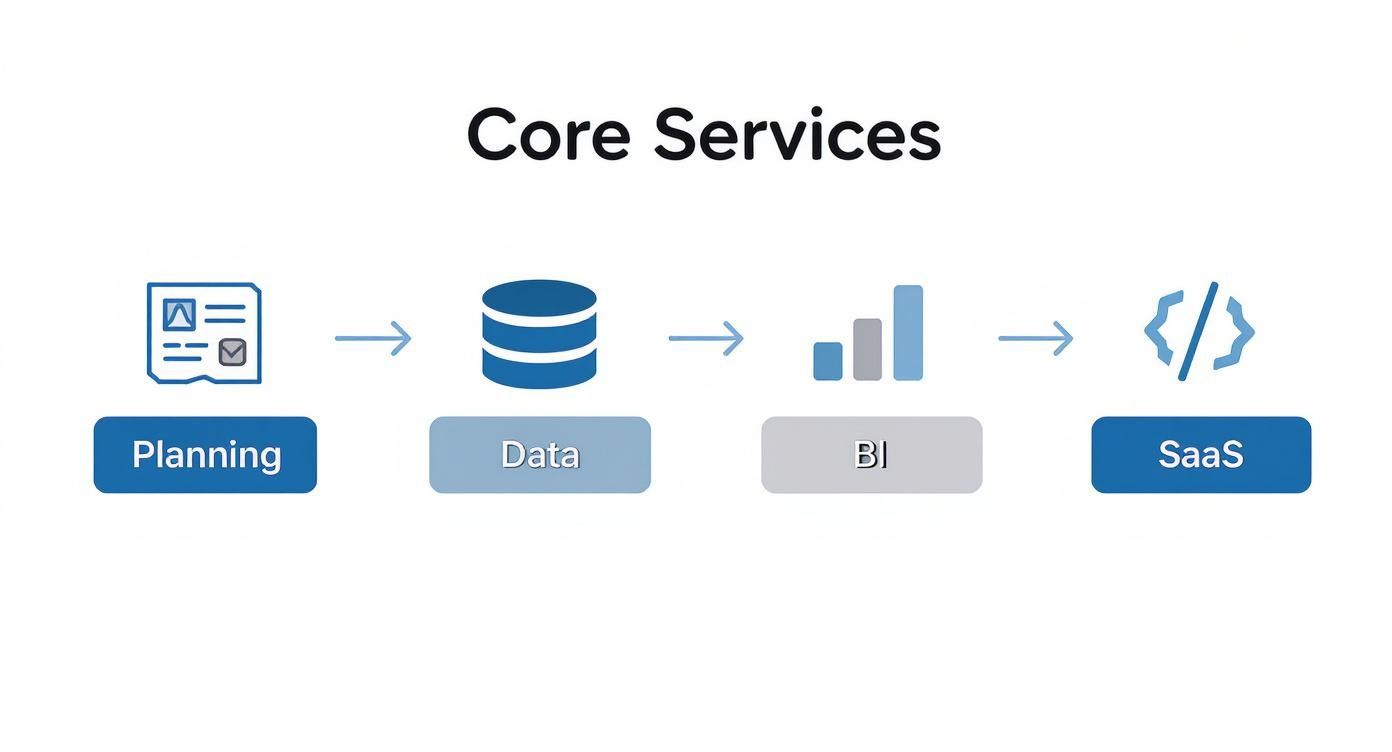
Each stage builds on the last, creating an integrated solution.
Phase 3: Implementation and Development – Bringing the Plan to Life
This is where strategy becomes a tangible reality. Our team gets to work, whether architecting data pipelines, designing intuitive Power BI dashboards, or building your custom SaaS application. We use an agile approach, building in short "sprints" and providing regular demos along the way.
This iterative process allows for flexibility. If your business needs shift or we uncover a new opportunity, we can adjust course without derailing the project.
This phase is built on constant communication. We work with you, not just for you, to ensure the final product meets your business needs precisely.
Phase 4: Handover and Support – Making Sure It Sticks
A project only succeeds if your team uses the new tools confidently. This final phase focuses on empowering your people through comprehensive training, clear documentation, and a solid support system.
We ensure your team feels a sense of ownership and has the skills to manage the new systems independently. Our goal is to make ourselves redundant in the day-to-day running of the solutions we build, leaving you with a sustainable asset, not a dependency.
Need help building your next Power BI dashboard or data automation workflow? Contact DataSimplified to discuss how we can turn your business data into powerful insights.
Measuring Your Transformation Return on Investment
Investing in a major business project requires confidence that it will pay off in concrete, measurable ways. Tracking the right metrics is how you prove that partnering with a business transformation agency is a smart strategic move, not just another expense.
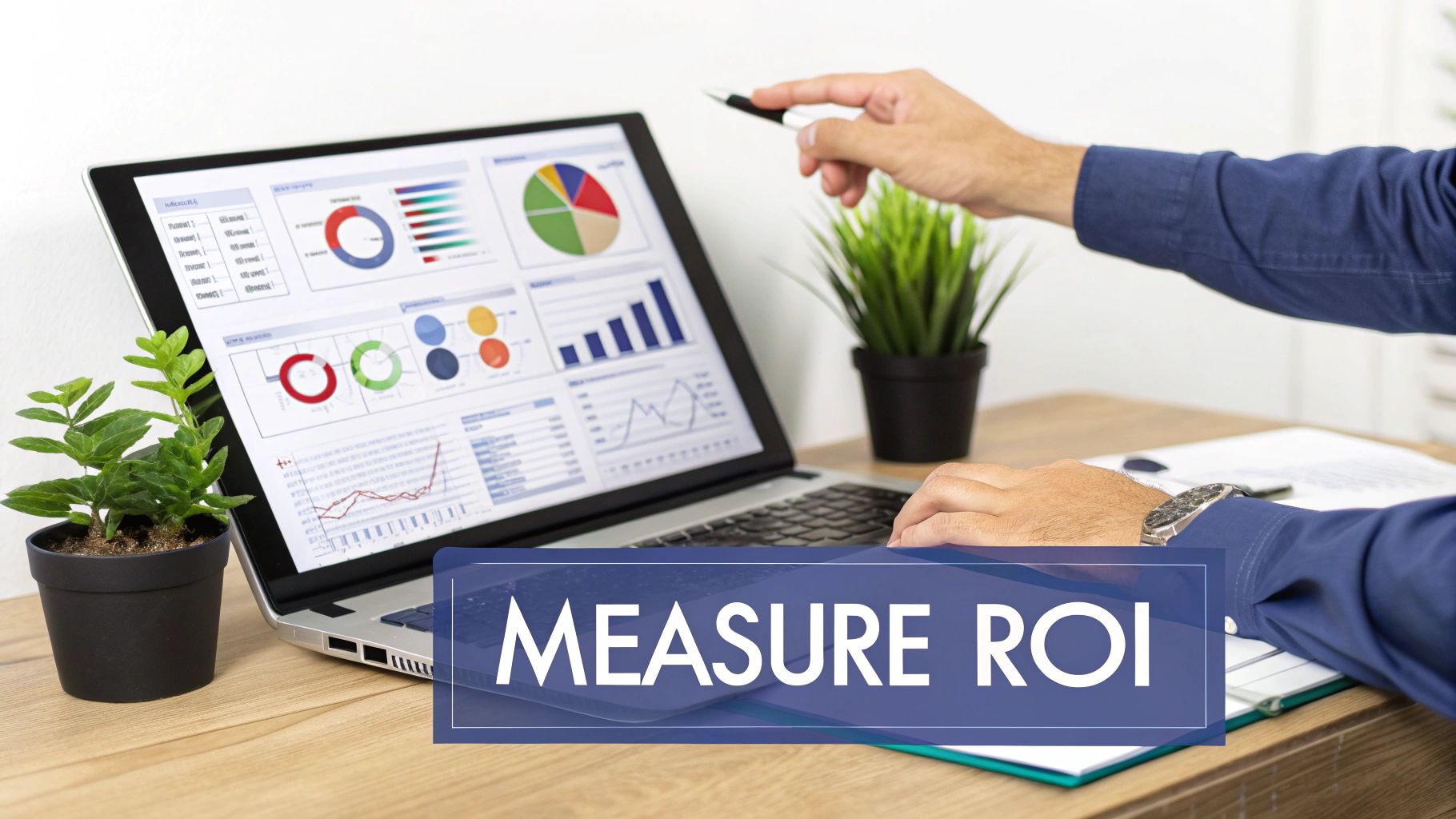
Identifying Your Core KPIs
Before work begins, we must agree on what success looks like—in numbers. The right Key Performance Indicators (KPIs) depend on the problem you’re trying to solve.
For example, if your team is drowning in manual reports, a critical KPI would be the reduction in manual reporting hours. If the goal is a more effective sales team, you’d track the increase in your lead conversion rate.
The most powerful KPIs tell a clear before-and-after story. They provide undeniable proof that the changes made have delivered quantifiable value.
This data-first approach creates accountability and keeps the project focused on outcomes that matter.
Real-World ROI Scenarios for SMEs
How does this play out for a South African business? Below are practical examples of how transformation projects can deliver a solid return on investment.
Example ROI From Transformation Projects
Here are practical examples of how different transformation initiatives can deliver both financial and operational benefits.
| Initiative | Key Metric | Potential Outcome for an SME |
|---|---|---|
| Data Automation | Time Saved on Admin Tasks | A local logistics company automated its fleet reporting and saved 40 hours per month, freeing up their operations manager to focus on route optimisation. |
| Business Intelligence | Stock Turnover Ratio & Profit Margin | A retail SME used Power BI dashboards to cut overstocked items by 15% and boost sales of high-margin products by 10%. |
| SaaS MVP Development | Reduction in Customer Support Queries | A service business built a client portal that led to a 30% decrease in support tickets within three months as customers could self-serve for common requests. |
Targeted technology solutions create measurable wins that directly impact your bottom line.
The Broader Impact On Business Performance
Beyond immediate financial returns, these projects often spark secondary benefits that boost your company’s long-term health, such as faster decision-making or improved employee morale from eliminating repetitive tasks.
South Africa is well-positioned for this, with over two-thirds of the continent's data centre capacity, making it a hub for digital innovation. This infrastructure allows local SMEs to leverage scalable cloud services that drive these performance gains. Learn more about South Africa's key role in digital transformation.
While knock-on effects like improved team morale can be harder to quantify, they are vital for sustainable growth.
Need help defining and achieving a clear ROI on your next project? Contact DataSimplified to discuss how our data engineering and Power BI services deliver results you can measure.
How to Choose the Right Transformation Partner
Picking the right business transformation agency is the most critical decision for your project. The right partner becomes an extension of your team, delivering results that set you up for long-term success.
The key is to ask direct questions that reveal what an agency can do and how they operate.
Assess Their Experience with SMEs
Many agencies showcase enterprise clients, but the challenges of a mid-sized business in Johannesburg are different. You need a partner who understands the SME landscape.
Ask them directly:
- "Can you show me case studies from companies our size in our industry?"
- "How do you tailor your approach for the budgets and timelines of a mid-market business?"
- "Tell me about a time you helped an SME achieve a significant win on a tight budget."
Their answers will reveal whether they have relevant, hands-on experience.
Scrutinise Their Technical Expertise
Your partner must have proven skills in the technologies powering your project. Vague claims of being "data-driven" are not enough. Confirm their expertise in data engineering, automation, and specific BI tools.
Robust vendor due diligence processes are key to ensuring a partner's technical claims are backed by a solid track record.
Drill down with questions like:
- "What is your team’s experience with Power BI, especially integrating data from different systems?"
- "Can you walk me through your typical data engineering workflow, from ETL to a data warehouse?"
- "What is your approach to building a SaaS MVP, and which technologies do you specialise in?"
A knowledgeable partner will welcome these questions and provide clear, detailed answers.
Evaluate Their Collaborative Approach
Transformation is a team effort. You are not just hiring a supplier; you are bringing in a strategic partner who must work closely with your people. A collaborative mindset and open communication are non-negotiable.
Our guide on how to choose the right data services outsourcing partner offers more insight on this.
Pay attention to how they engage with you from the first call. A genuine partner is interested in building a solution with you, not just selling a one-size-fits-all package to you.
Need help finding a partner with the right technical and strategic fit? Contact DataSimplified to discuss how we build solutions tailored for SMEs.
Common Transformation Pitfalls to Avoid
Even well-intentioned projects can fail. Learning from the mistakes of others is one of the smartest ways to protect your investment of time and money. A good partner doesn't just build solutions; they help you navigate the potential roadblocks ahead.
Spotting these common issues early can turn a project-killing obstacle into a manageable challenge.
Starting with Unclear Objectives
The primary reason projects fail is fuzzy goals. A company wants to "improve efficiency" or "become more data-driven," but without clear definitions, these goals are impossible to measure and almost guarantee a disappointing result.
The fix is to be specific. Before any work begins, define what success looks like in concrete terms. Instead of "improving efficiency," a better goal is "reduce time spent on manual invoicing by 50% within six months." This is a clear target everyone can work towards.
A project without clear goals is like a ship without a rudder. Defining success upfront provides the direction needed to navigate the entire journey.
Choosing Technology Before the Problem
It's easy to be impressed by the latest software, but buying a tool before diagnosing the business problem is a classic mistake. This "solution-first" approach often leads to expensive, underused software that doesn't solve your team's real-world challenges.
Always start with the problem. A good agency will conduct a thorough discovery phase to understand your workflows and pinpoint the root cause of friction. Only then can you find or build the right solution—whether a Power BI dashboard or a custom SaaS MVP—that is a perfect fit for the job.
Overlooking Change Management
You can build the most brilliant tool, but if your team doesn't understand, trust, or use it, the project is a failure. Forgetting the human side of change is a critical error. Change management is not an add-on; it's a core part of a successful project.
A successful transformation plan must include:
- Early Involvement: Involve key team members from the start. When they help build it, they feel ownership.
- Clear Communication: Consistently explain why changes are happening and what the benefits are for them.
- Thorough Training: Provide hands-on training and ongoing support to build confidence and competence.
Failing to Secure Team Buy-In
Genuine buy-in from the people using the new systems daily is essential. People naturally resist change, especially when it feels forced upon them. This leads to low adoption, workarounds, and even active resistance.
Reframe the project as a collaborative effort to improve their jobs. Show them how a new dashboard eliminates a painful spreadsheet or how automation removes hours of repetitive tasks. This approach turns sceptics into your biggest advocates.
Need help building a transformation strategy that avoids these common pitfalls? Contact DataSimplified to discuss how we can turn your business data into powerful insights.
Your Top Transformation Questions, Answered
If you're considering a transformation project, you likely have some practical questions. Here are answers to the most common ones we hear from business owners and managers.
Is My Business Too Small for This?
Definitely not. It's a myth that sophisticated data tools are only for large corporations. Modern, scalable technology and agile methods make these solutions accessible for smaller businesses.
For an SME, transformation isn't about a massive, multi-year overhaul. It's about smaller, smarter projects. It could be a single Power BI dashboard to clarify your sales pipeline or automating one manual task. These targeted projects deliver a quick, measurable return and can scale with your business.
How Long Does a Typical Project Take?
The timeline depends on the project's scope. However, our goal is always to deliver value quickly. We avoid long, drawn-out projects by breaking them into manageable phases.
We often start with a Minimum Viable Product (MVP)—the simplest version of a solution that solves your biggest problem now. This approach means you could have a working tool, like a basic SaaS app or an initial automation workflow, in a matter of weeks, not years. From there, we build on it using your real-world feedback.
Consultant vs. Agency: What’s the Difference?
This is an important distinction. A consultant typically analyses your business and provides a strategy or report. A business transformation agency does that and then builds and implements the solution.
An agency is your hands-on partner. We don't just advise; we execute. This means we’re accountable for the entire journey, from data engineering and software development to training your team.
What Kind of Data Do I Need to Start?
You don't need perfect, clean data to begin. Most businesses have valuable information, even if it's messy and scattered across different systems like accounting software, a CRM, or spreadsheets.
The first step is to work with what you have. Our data engineering process starts by connecting to these sources, cleaning the information, and organising it into something reliable and useful. The journey begins where you are today.
Still have questions? DataSimplified helps businesses turn their challenges into growth opportunities. Get in touch with us today to start the conversation.
Article created using Outrank
